If you’ve ever stood in a kitchen store staring at a $400 Le Creuset next to a $70 Lodge and wondered what you’re actually paying for, this article is your answer — at least when it comes to chili. An enameled Dutch oven is a heavy pot with a thick cast-iron body coated in a glassy, porcelain-like finish (the enamel). That coating means you don’t need to season it like bare cast iron, it won’t react with acidic ingredients like tomatoes or chiles, and cleanup is relatively painless. For a long-simmered pot of chili — where you’re browning meat, blooming dried spices, and holding a low, even heat for an hour or more — this style of pot is genuinely the right tool. The question isn’t whether to use one. The question is how much you need to spend before the performance difference becomes real, and where spending more just buys bragging rights.
That’s the diminishing-returns curve. And it does bend — just not where most people expect.
What “Performance” Actually Means for Chili
Before you can evaluate where the curve bends, you need a clear definition of what “better” looks like inside a chili pot. There are four variables that matter:
Heat distribution. Chili scorches on the bottom if your pot has hot spots — localized areas that run significantly hotter than the surrounding surface. Thick walls and a heavy base slow heat transfer enough to even things out. This is the single most important performance variable for a long braise or simmer.
Heat retention. Once you’ve brought that pot up to temperature, you want it to stay there with minimal intervention. A heavy pot that holds heat well means your simmer doesn’t collapse every time you lift the lid to stir.
Enamel durability. Chips, cracks, and staining aren’t just cosmetic — a chipped enamel surface can harbor bacteria and, in worst cases, expose the raw iron beneath to your food. Enamel quality varies meaningfully between manufacturers, and it’s one of the few areas where price genuinely correlates with real-world performance over time.
Lid fit and moisture management. A well-fitted lid keeps moisture cycling back into the pot — critical for a chili that simmers uncovered for finishing. A loose lid loses moisture unevenly. A tight lid with a good seal gives you control.
Notice what’s not on the list: color options, brand heritage, warranty language, aesthetic weight of the knob, or country of manufacture as a proxy for quality. Those things matter to some buyers. They don’t matter to the chili.
The Three Price Tiers — and What You Actually Get
The enameled Dutch oven market for a standard 5.5- to 6-quart pot clusters into three meaningful tiers as of May 2026.
Tier 1: $50–$100 (Lodge Enameled Cast Iron, Cuisinart, Tramontina)
Lodge’s enameled Dutch oven is the most-discussed entry point in this category, and it earns that position. Based on published specs, the Lodge runs a heavier base than comparable budget competitors, which contributes to the heat distribution story. Wirecutter’s Dutch oven review notes Lodge as a credible workhorse pick, and owners across long-run reviews consistently report solid browning performance and manageable enamel durability through several years of regular use.
The honest tradeoffs at this tier: the interior enamel is slightly rougher in texture than premium competitors (visible under magnification, and you can feel it when dragging a wooden spoon), which means minor sticking is more common during the initial high-heat meat-browning phase. The enamel is also less forgiving of thermal shock — moving a hot Lodge pot to a cold surface or running cold water into a hot pot is a known risk factor for crazing (hairline cracks in the enamel finish). Reviewers at Serious Eats note this as a category-wide limitation for budget enamel, not specific to Lodge alone.
The call: If you’re building your first real chili setup and you’re putting money into ingredient quality — Rancho Gordo dried beans, fresh Penzeys chili powders, a proper selection of whole dried anchos and guajillos — a Lodge enameled Dutch oven is a legitimate choice. You are not leaving significant cooking performance on the table versus a $400 pot for an everyday 6-quart batch.
Tier 2: $150–$250 (Staub, Made In, Misen)
This is where the curve starts to bend, and it bends in Staub’s direction more than any other brand in this tier. Staub’s interior is black matte enamel rather than the cream or gradient interior common on Le Creuset and Lodge. That black surface is deliberately rough at the micro-scale — it creates more contact points for meat during browning, which owners consistently report as better fond development (the browned bits that stick to the bottom and get incorporated into the chili base for flavor).
Staub also builds a heavier lid with a textured interior dimple pattern that the brand calls “self-basting” — condensation collects on the bumps and drips back down onto the food rather than running to the edges. For a covered braise, this matters. For a chili you’re finishing uncovered, it matters less, but the lid seal quality still contributes to your covered-simmer phase.
Cook’s Illustrated’s Dutch oven review has historically rated Staub highly for oven performance, and Food52’s test kitchen coverage notes that the Staub lid’s tight fit is a genuine functional difference versus more loosely toleranced competitors.
Made In’s enameled Dutch oven, introduced at a slightly lower price point than Staub, has attracted significant attention from serious home cooks. Published specs put the wall thickness in competitive range with Staub, and owners in long-run reviews generally report heat evenness consistent with the tier. The enamel interior is lighter in color (similar to Le Creuset), which means it’s easier to monitor fond development visually — a meaningful advantage for cooks who are still calibrating the browning-without-burning line.
The call: If you’re cooking chili more than twice a month, running competition-adjacent batches, or if the pot will see oven use (finishing a chili in the oven is genuinely useful for controlled, all-around heat), the jump from Tier 1 to Tier 2 delivers real, recurring cooking returns. The Staub is the pick here if browning performance is your priority. Made In is the pick if you want better visual feedback during the cooking process.
Tier 3: $300–$500+ (Le Creuset)
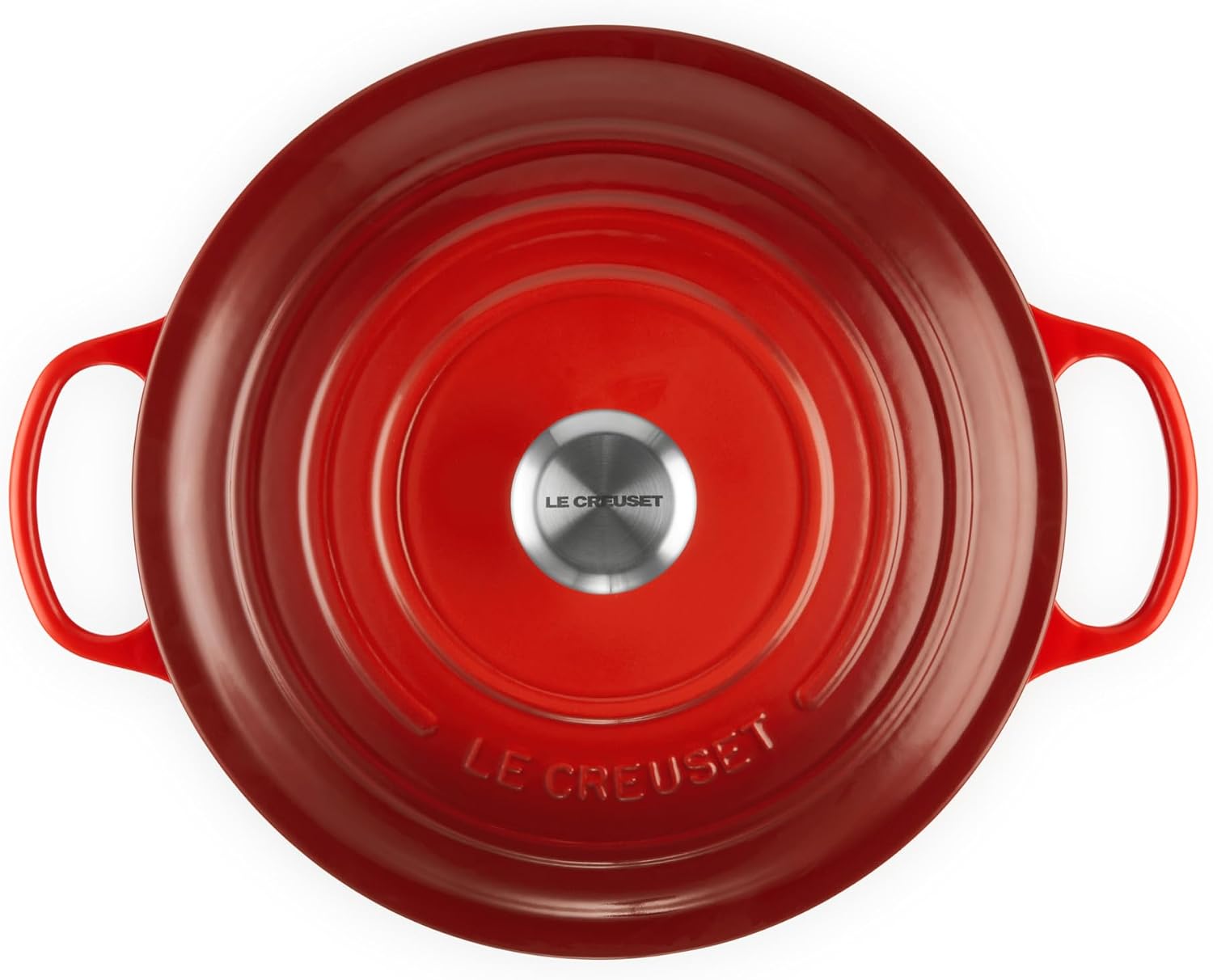
Le Creuset is the market-defining brand at this price, and the reality is more nuanced than either its advocates or its critics usually acknowledge.
The Le Creuset enamel is, by reputation and by the consistent pattern across aggregated owner reviews, the most durable in the category over long timeframes. The light sand interior enamel is exceptionally smooth, which reduces sticking and makes cleaning easier. The colorways are more varied than competitors. The brand’s warranty is well-structured.
But here’s where the curve flattens for chili specifically: the cooking performance difference between a Staub in the $220–$250 range and a Le Creuset at $380–$420 is, based on published spec comparisons and consistent reviewer consensus at Serious Eats and Wirecutter, marginal to nonexistent for stovetop-to-oven chili applications. The Le Creuset lid is lighter than Staub’s, which means slightly less downward pressure and (depending on the specific model) a marginally less tight seal. That’s a tradeoff, not a deficiency — but it’s not a reason to pay more.
Where Le Creuset earns its premium: longevity calculus over a 15–20 year use horizon, resale value if you ever sell it, and the customer service experience if you ever need warranty support. Those are real considerations. They’re not performance considerations for the next 100 pots of chili.
By the Numbers
| Tier | Price Range | Enamel Type | Lid Seal | Primary Advantage |
|---|---|---|---|---|
| Lodge | $50–$80 | Cream interior, standard gloss | Good | Value-to-function ratio |
| Staub | $220–$260 | Black matte, rough micro-texture | Excellent (heavy lid) | Fond development, moisture retention |
| Le Creuset | $360–$420 | Light sand, ultra-smooth | Good (lighter lid) | Long-term durability, warranty |
The One Variable Nobody Talks About: Burner Compatibility
If you’re cooking on a residential gas burner — the most common setup for home chili cooks — all three tiers perform comparably in terms of heat distribution, because the burner’s flame pattern is the main variable, not the pot. A wide, even flame distribution (common on higher-BTU pro-style ranges) is the bigger factor.
On induction, the equation shifts. Enameled cast iron is induction-compatible across all three tiers, but the heavier base thickness of Staub and Le Creuset translates to faster, more even response on an induction surface compared to Lodge. If you’re cooking on a precision induction burner — including the Breville Control Freak, which lets you set exact temperatures and hold them within a degree — you will notice the baseplate quality difference. The control you’re paying for in that burner is partially undermined by a pot that doesn’t transfer heat evenly. This is one genuine case where the premium pot earns its price in a direct, functional way.
The Decision Rule
Here’s the framework, stated plainly:
If your budget is under $100: Buy the Lodge. Put the savings into better dried chiles and a quality spice selection. The pot will not be your limiting factor.
If your budget is $150–$300 and you cook chili regularly: Buy the Staub. The enamel durability, fond development, and lid seal are meaningful upgrades that pay back over dozens of batches. This is where the curve bends — the performance jump from Tier 1 to Tier 2 is real; the jump from Tier 2 to Tier 3 is mostly marginal for cooking purposes.
If your budget is $300+ and you’re cooking on induction precision equipment, running competition batches, or buying a pot you expect to use for 20 years: The Le Creuset is a legitimate choice, but be clear-eyed that you’re buying durability and brand infrastructure, not meaningfully better chili. If cooking performance is the only metric, the Staub at $250 and the Le Creuset at $400 are in the same tier.
If you’re buying as a gift for a serious cook: Staub is the right call. It signals that you understand the performance conversation, it will outlast most kitchen tools the recipient owns, and it doesn’t come with the “I just paid for the name” subtext that sometimes follows a Le Creuset gift.
The curve bends at Staub. Everything above it is about how long you want the pot to last and how much you care about the brand on the side — which are legitimate reasons to buy. They’re just not chili reasons.