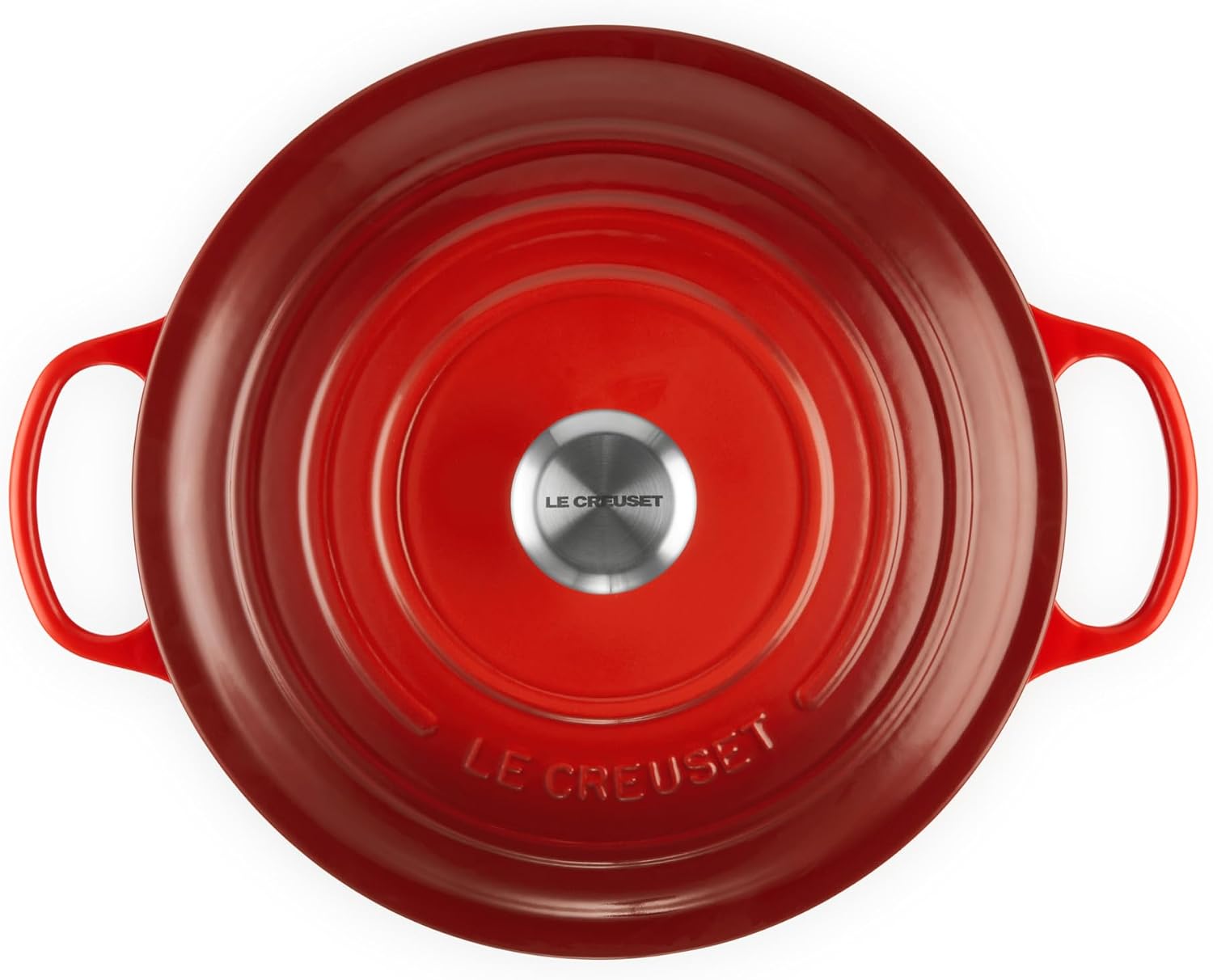
A Dutch oven is a heavy, lidded pot — typically cast iron coated with a glassy enamel finish — built to hold heat evenly and for a long time. For chili, that matters more than almost any other equipment factor. A great batch depends on a slow, steady simmer where the bottom doesn’t scorch, heat wraps around every bean and chunk of meat, and the lid traps moisture at exactly the rate you want. The pot is doing real work. The question is how much pot you actually need — and whether spending $400 buys you a meaningfully better bowl, or just a prettier one. This guide breaks down three tiers: Le Creuset (the luxury benchmark), Lodge (the workhorse standard), and the crowded $40–$60 field — with honest analysis of where performance gaps are real and where they’re mostly marketing.
| EDITOR'S PICKCuisinart Chef's Classic Enamel… | Mid-tier[Lodge Essential Enamel Cast Iro](https://www.amazon.com/dp/B07Q2VXV4K?tag=greenflower20-20)… | Budget pick[Crock-Pot Artisan 7-Quart Round](https://www.amazon.com/dp/B01H0CFMPS?tag=greenflower20-20)… | |
|---|---|---|---|
| Capacity | 7-Quart | 6 Quarts | 7-Quart |
| Material | Enameled Cast Iron | Enamel Cast Iron | Enameled Cast Iron |
| Oven Safe | ✓ | — | — |
| Induction Compatible | ✓ | — | — |
| Color | Cardinal Red | — | Slate Gray |
| Price | $111.19 | $89.90 | $49.73 |
| See on Amazon → | See on Amazon → | See on Amazon → |
What You’re Actually Paying For: The Spec-Sheet Reality
Before comparing brands, it helps to understand what separates a $350 Le Creuset from a $50 Lodge beyond the color palette and the country of origin stamped on the bottom.
Wall thickness and thermal mass. Cast iron’s value in a chili pot is thermal mass — the ability to absorb a large amount of heat and release it slowly and evenly. Thicker walls mean more mass and more stable cooking temperatures. Published manufacturer specifications place Le Creuset’s 5.5-quart Dutch oven at approximately 11.8 lbs and Lodge’s 6-quart at approximately 13.1 lbs. Counterintuitively, Lodge is the heavier pot. The difference isn’t dramatic at the stove, but it matters over a long cooking session when you’re lifting a full pot of chili onto a trivet.
Enamel quality and surface behavior. The enamel interior — the light-colored glassy coating that prevents bare iron from reacting with acidic ingredients — is where premium pricing is most defensible. Cook’s Illustrated’s Dutch oven equipment testing roundup has repeatedly noted that Le Creuset’s interior enamel is harder, more chip-resistant over years of use, and releases fond (the browned, flavorful residue that builds during the browning phase) more reliably than most budget competitors. Lodge’s interior enamel has improved noticeably across recent product generations and performs well for the first several years with proper care. Budget-tier enamel is where the gap widens sharply — more on that below.
Lid fit and moisture management. For chili, the lid is not decorative. A tight-fitting lid controls evaporation rate, which determines whether your chili thickens to a spoonable consistency or collapses into a paste. Serious Eats’ Dutch oven equipment review has consistently flagged lid fit as a differentiating factor across price tiers. Le Creuset lids are precision-machined; Lodge lids fit well but with slightly more unit-to-unit variation; budget lids are the most inconsistent, occasionally requiring a foil tent to achieve the seal you want.
The Three-Tier Breakdown
Le Creuset Enameled Cast Iron Dutch Oven (5.5 qt, ~$350–$400 retail in May 2026)
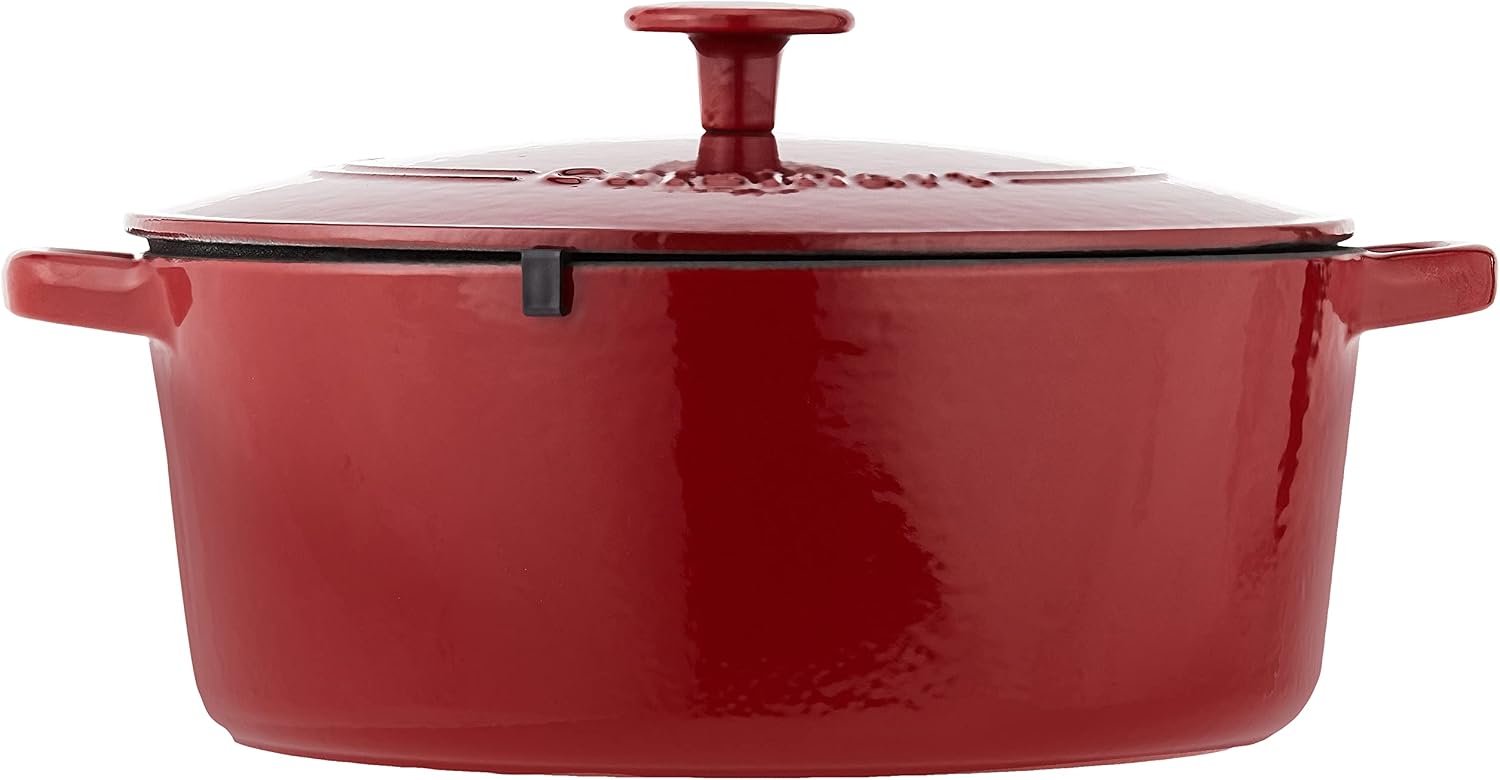
Cuisinart
$111.19
In stock on Amazon
Check price on AmazonThis is the pot that gets handed down. Apartment Therapy, in their analysis titled “Is a Le Creuset Worth the Price?”, notes that the company’s lifetime warranty is functionally meaningful — owners report defect replacements handled without friction — and that pots purchased decades ago still perform identically to new ones. For chili cooking specifically, the performance ceiling is real: the pale sand-colored interior makes it easy to monitor fond development during the browning phase, the heat distribution is exceptionally even across the base, and the pot handles high-acid tomato-forward chilis over years of use without staining or pitting.
The honest tradeoff: you are paying a significant premium for durability, warranty confidence, and a manufacturing standard that sits at the ceiling of the enameled cast iron category. The actual chili that comes out of a Le Creuset versus a well-maintained Lodge is not categorically different. Food52, in their overview piece “Everything You Need to Know About Dutch Ovens,” makes this point plainly — the best chili achievable in a Le Creuset is achievable in a Lodge. What Le Creuset buys you is decades of consistent performance and zero anxiety about the vessel becoming a variable in your cooking.
Who should buy it: Anyone cooking chili multiple times a week, competition cooks who want zero equipment variables, or gift-givers looking for a genuinely permanent kitchen tool. The cost-per-use math favors Le Creuset heavily if the pot gets serious use over 10 or more years.
Cuisinart
$111.19
In stock on Amazon
Check price on AmazonLodge Enameled Cast Iron Dutch Oven (6 qt, ~$60–$80 retail in May 2026)
Lodge
$89.90
In stock on Amazon
Check price on AmazonLodge is the answer to the question: “What’s the best Dutch oven if I’m not willing to spend Le Creuset money?” Wirecutter’s guide titled “The Best Dutch Oven” has named Lodge’s enameled line a top pick in the value category for multiple consecutive years, specifically citing its performance-to-price ratio for everyday cooking tasks. The pot browns meat well, holds a simmer without hot spots on both gas and electric ranges, and cleans up without heroic effort.
The real-world performance gap between Lodge and Le Creuset for chili narrows considerably when you’re comparing new pot to new pot. Where Lodge falls behind over time: the enamel is more susceptible to chipping if the pot is dropped or subjected to sudden temperature changes — thermal shock, meaning a screaming-hot pot placed directly into cold water. Some owners in long-run reviews also note that the interior can darken and become slightly more reactive with high-acid chilis after several years of heavy use.
Lodge’s heavier weight is worth acknowledging. At more than 13 pounds empty, a full 6-quart pot of chili is a two-handed operation for most cooks. For anyone with wrist or grip concerns, this is a genuine factor rather than a minor inconvenience.
Who should buy it: The engaged beginner making their first major kitchen investment, the intermediate cook who wants pro-level results without luxury-level spending, or anyone who would rather replace a $70 pot than a $380 one if something goes wrong.
Lodge
$89.90
In stock on Amazon
Check price on AmazonThe $40–$60 Budget Field (Tramontina and Import Generics, ~$40–$65 retail in May 2026)
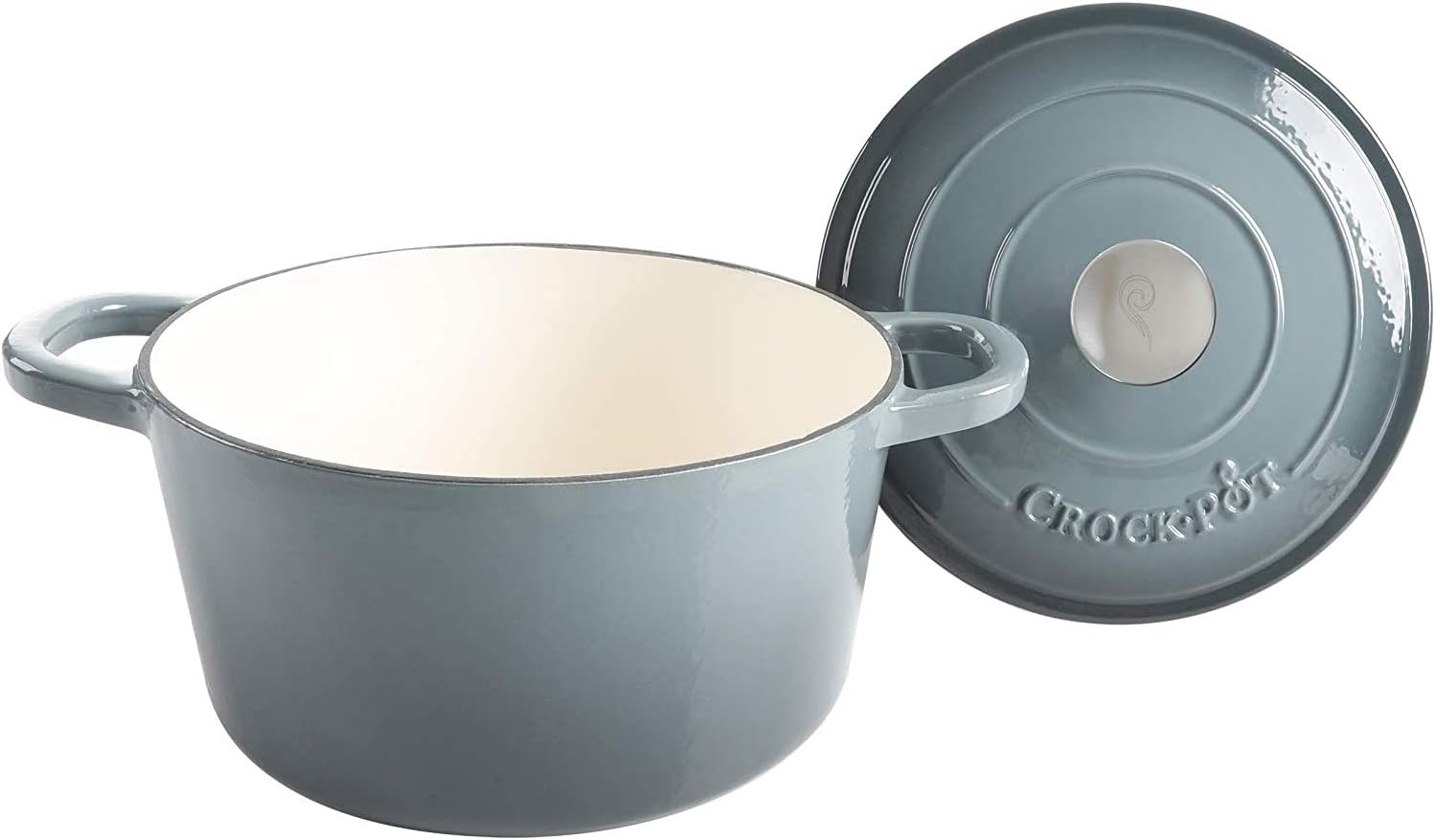
Crock-Pot
$49.73
In stock on Amazon
Check price on AmazonThis tier is where the comparison gets complicated, because the range within it is enormous. Tramontina’s enameled Dutch oven — widely available in the $50–$65 range — has a notably strong reputation relative to its price. Cook’s Illustrated has included Tramontina in their Dutch oven equipment testing roundup and found its performance competitive with Lodge on even heat distribution, with acceptable enamel quality for the price. Serious Eats’ Dutch oven equipment review similarly identifies Tramontina as the most consistently defensible option in this price band. If you’re choosing a budget pot, Tramontina is the name that culinary publications and equipment reviewers consistently surface as the best available option in this tier.
Generic import pots at $30–$45 are a different story. The pattern across long-run owner experience is consistent: acceptable performance for the first year, increasingly unreliable after that. Enamel chips more readily, lids fit poorly, and hot spots develop on the cooking surface. For chili — which depends on low-and-slow cooking where even heat is essential — a pot with hot spots is a real liability. The bottom scorches before the center of the pot reaches the temperature you want.
One specific failure mode matters for chili cooks: budget enamel tends to stain permanently from chile powders and dried pepper pigments — the same compounds that give ancho and guajillo their deep red color. It is cosmetic rather than functional, but owners in long-run reviews consistently find it demoralizing. Le Creuset’s pale interior enamel resists this well; Lodge’s is moderate; bargain-tier enamel tends to absorb and hold color after a relatively short period of use.
Who should buy it: Someone who needs a Dutch oven immediately, plans to upgrade within two or three years, or is genuinely uncertain whether serious chili cooking will become a regular practice. At this tier, buy Tramontina specifically — it is the one budget option with consistent multi-source editorial backing from Cook’s Illustrated’s Dutch oven testing roundup and Serious Eats’ Dutch oven equipment review. Avoid unbranded generics for any chili that requires more than an hour of active simmering.
Crock-Pot
$49.73
In stock on Amazon
Check price on AmazonBy the Numbers
| Pot | Approx. Price (May 2026) | Weight (empty) | Warranty | Interior Enamel Grade |
|---|---|---|---|---|
| Le Creuset 5.5 qt | $350–$400 | ~11.8 lbs | Lifetime | Excellent |
| Lodge 6 qt | $60–$80 | ~13.1 lbs | Limited lifetime | Good |
| Tramontina 6.5 qt | $50–$65 | ~12 lbs | 1 year | Fair–Good |
Cuisinart
$111.19
In stock on Amazon
Check price on AmazonLodge
$89.90
In stock on Amazon
Check price on AmazonCrock-Pot
$49.73
In stock on Amazon
Check price on AmazonEnamel grade based on published comparisons from Cook’s Illustrated’s Dutch oven equipment testing roundup and Wirecutter’s “The Best Dutch Oven” guide, supplemented by aggregated owner experience across long-run reviews. Not based on independent testing by this publication.
Where the Performance Curve Actually Bends
Here is the honest version of the diminishing-returns question every serious chili cook eventually faces.
From $40 generic to Lodge (roughly $30–$40 incremental cost): The gap is large and real. You get meaningfully better enamel, better lid fit, and a pot that will still perform predictably after five years of hard use. This upgrade is almost always worth making. Wirecutter’s “The Best Dutch Oven” guide makes this case explicitly in its tier analysis, noting that the jump from no-name imports to a recognized brand represents the single largest performance gain per dollar in the Dutch oven category.
From Lodge to Le Creuset (roughly $280–$320 incremental cost): The gap exists but is narrower than the price difference implies. You are buying a higher durability ceiling, lifetime warranty confidence, and a modest edge in browning performance and enamel longevity. The chili you produce will be slightly better positioned for consistency over years of use; the equipment-ownership experience — the confidence that the pot will never introduce uncertainty into your process — is where Le Creuset earns its price for serious or competitive cooks. Apartment Therapy’s “Is a Le Creuset Worth the Price?” frames this as a question of time horizon: over a decade of heavy use, the per-cook cost of a Le Creuset approaches that of a Lodge.
From Tramontina to Lodge (roughly $10–$20 incremental cost at most retail points): Worth it. If Lodge is available at a price within $15–$20 of Tramontina at your point of purchase, the enamel quality and lid fit improvement is a genuine functional upgrade, not a marginal one.
The Decision Rule
If you’re making chili once or twice a month and still building your practice: buy Lodge. It performs at a level that will not limit you, costs a fraction of the premium option, and is widely available. The money saved is better spent on higher-quality dried chiles or a dedicated spice grinder — both of which will affect your finished bowl more than a pot upgrade would.
If you’re cooking chili three or more times a week, entering competitions, or treating your kitchen equipment as a long-term investment: buy Le Creuset. The cost-per-use math over a decade of serious cooking is genuinely favorable, and removing equipment anxiety from your process has real value when you are dialing in a recipe for a competition or a crowd.
If budget is the binding constraint right now: buy Tramontina, not a generic. Accept that you’re purchasing a two-to-three year pot rather than a forever pot, and plan the upgrade accordingly. The Tramontina will not embarrass you; an unbranded generic might.
The pot matters. But the dried chiles, the technique, and the patience to let the simmer do its work matter more. The best chili made in a Lodge will beat a mediocre chili made in a Le Creuset every time — which means the first investment is always the cook’s knowledge, and the second is the vessel.
How the Tiers Compare
For readers weighing price against capability, here’s how the standout picks break down by budget level.
Best Budget Pick
At $49.73, this is the value option in this lineup — it covers the essentials without the premium-tier cost, the smart starting point if you’re weighing price against capability.
Crock-Pot
$49.73
In stock on Amazon
Check price on AmazonBest Mid-Range Pick
At $89.90, this is the balanced choice — it closes most of the gap to the high end while staying well short of premium pricing, which is why it’s the pick most buyers actually land on.
Lodge
$89.90
In stock on Amazon
Check price on AmazonBest Premium Pick
At $334.91, this is the top performer here — you pay for it, but if capability and longevity matter more than the upfront cost, this is the one to beat.
Cuisinart
$111.19
In stock on Amazon
Check price on Amazon