If you’ve ever shopped for a pot to make chili from scratch, you’ve probably run straight into the enameled cast iron conversation — that’s the kind where a porcelain coating (enamel) fuses to the outside and inside of a heavy iron pot, giving you a smooth, non-reactive surface that doesn’t need any special care after cooking. Brands like Le Creuset and Staub built their reputations on it, and for good reason. But there’s an older, cheaper, and in some ways more capable option sitting right next to those pots on the shelf: bare cast iron. No coating. Raw iron, seasoned with oil, which means the surface is built up by cooking rather than applied in a factory. This article is for the cook who’s looked at a $400 enameled Dutch oven and wondered whether the premium is actually justified for chili — or whether a $60 bare iron pot might do the job better in some situations. The answer, as with most honest gear questions, is: it depends. Let’s work through the tradeoffs.
| EDITOR'S PICKLodge Seasoned Cast Iron Camp D… | Mid-tierLodge Cast Iron Dutch Oven 7 Qu… | Budget pickLodge Cast Iron Double Dutch Ov… | |
|---|---|---|---|
| Capacity | 6 Quart | 7 Quart | 5 Quart |
| Type | Camp Dutch Oven | Dutch Oven | Double Dutch Oven |
| Handle Type | Dual Handles | Loop Handle | — |
| Pre-Seasoned | ✓ | — | ✓ |
| 2-in-1 Design | ✗ | ✗ | ✓ |
| Lid Type | Strong Lid | — | — |
| Price | $79.99 | $79.90 | $59.90 |
| See on Amazon → | See on Amazon → | See on Amazon → |
What Bare Cast Iron Actually Does Differently — and Why Chili Is a Good Test Case
Chili stresses cookware in specific ways. You’re typically searing a large volume of meat at high heat, then building a sauce with tomatoes and other acidic ingredients, then simmering for anywhere from 45 minutes to four hours. That sequence — high-heat browning followed by long, low acidic cooking — is where bare iron and enameled iron genuinely diverge.
On the searing side, bare iron wins. Enameled cast iron is rated by most manufacturers for stovetop temperatures up to around 500°F, and some brands recommend keeping the heat below medium on the stovetop to protect the enamel from thermal shock. Bare iron has no such ceiling. You can preheat it aggressively, get the surface screaming hot, and sear meat in smaller batches without worrying about damaging the vessel. Wirecutter’s cast iron coverage notes that the fundamental advantage of uncoated iron is its tolerance for extreme heat and its ability to build a cooking surface that improves through use — something no enamel coating replicates.
On the long acidic simmer, enamel has the edge — with caveats. Tomatoes, chili powder, and dried chiles all introduce acidity. Over a long, slow simmer, bare iron will react with acidic ingredients in two ways: it can leach small amounts of iron into the food (not dangerous and in fact a minor nutrient benefit, per Food52’s cast iron care guide), and it can gradually strip the seasoning from the cooking surface. This doesn’t make bare iron unusable for chili — cooks have been making tomato-based dishes in bare iron for generations — but it does mean you’ll re-season more frequently than you would with a pot that never touches the food.
The tradeoff in plain language: bare iron is the better searing vessel and the worse acidic-simmer vessel. Whether that balance tips in favor of bare iron depends on how you cook.
The Double Dutch Oven: Why the Skillet Lid Changes the Math
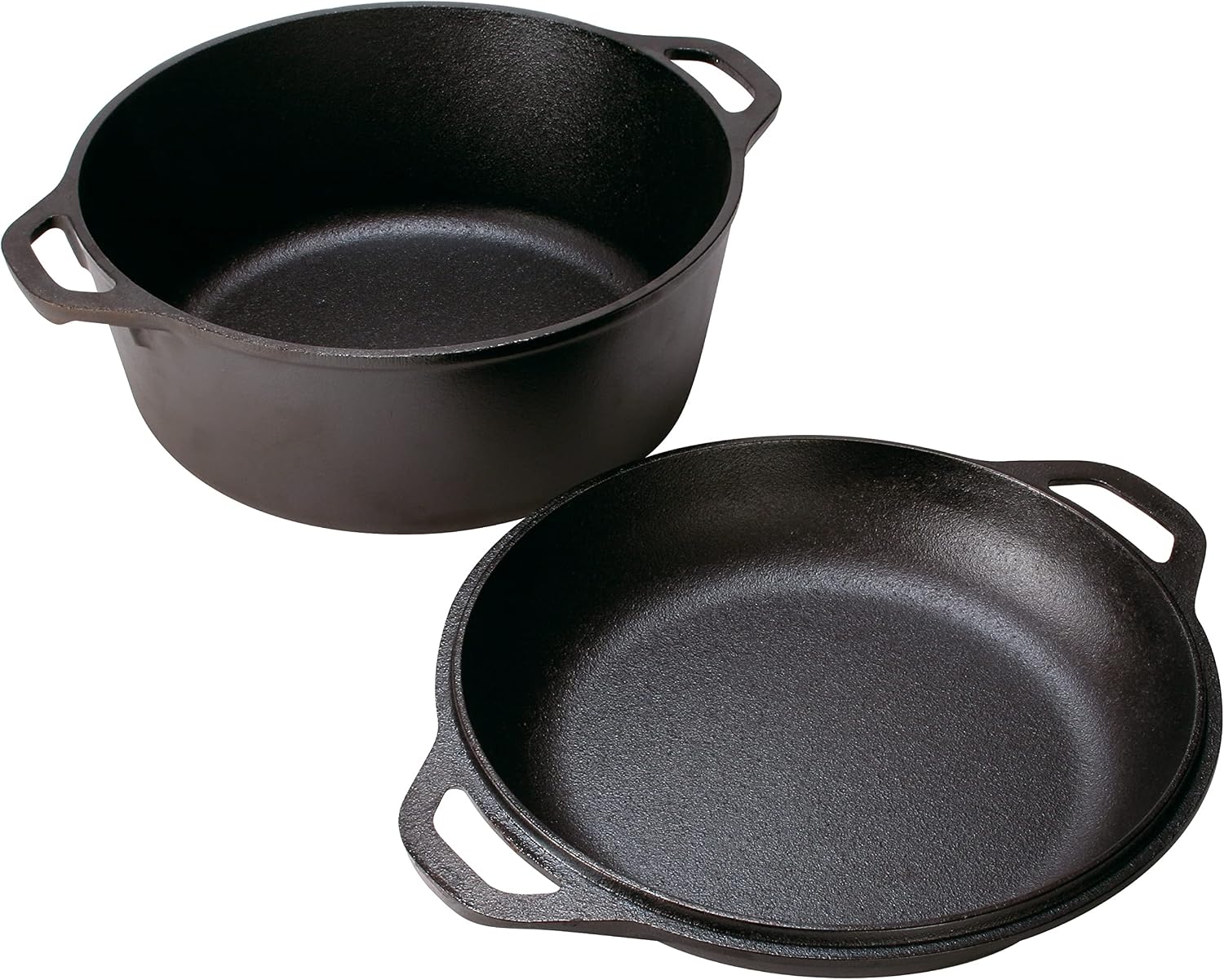
The Lodge Double Dutch Oven is a specific product format worth understanding before you buy anything. It’s a bare cast iron Dutch oven — typically available in 5-quart capacity — that ships with a lid designed to pull double duty. The lid is a shallow skillet with a flat bottom and a loop handle, meaning you can flip it over, set it on the burner, and use it as a standalone frying pan.
For chili, this isn’t a gimmick. Owners report using the skillet lid to sear ground beef, diced chuck, or pork in batches before moving those seared portions into the pot for the long braise. One seven-year Lodge owner noted in their review that searing meat in the lid before transferring it to the pot had become their preferred workflow — specifically because the shallow lip of the skillet makes it easier to drain fat and manage browning without steaming, and because the lid preheats quickly given its relatively thin profile compared to the pot itself.
The Lodge Chef Collection Double Dutch extends this concept with a slightly updated profile and handle design aimed at better oven compatibility, and it draws similarly loyal reviews — including one owner who described actively replacing higher-end pots in their kitchen with Lodge pieces after experiencing the Chef Collection line.
By the numbers — Double Dutch format at a glance:
| Piece | Function | Approx. capacity |
|---|---|---|
| Pot | Dutch oven / braiser | 5 qt |
| Lid (inverted) | Skillet / sear pan | ~10 in. diameter |
| Combined system | Chili cook + sear station | Full batch to ~4 servings |
The five-quart format is a real constraint to flag: a competition-sized or family-sized chili batch, which typically runs six to eight quarts finished, will overflow this pot. The Double Dutch is the right call for a two-to-four serving recipe or for a cook who plans to build flavor in the pot and finish the batch in a larger vessel.
Camp Ovens and 7-Quart Bare Iron: When You Need More Room
If the Double Dutch’s dual-purpose lid is its defining feature, the Lodge 7-Quart Camp Dutch Oven’s defining feature is its legs. Camp Dutch ovens — a format that’s been standard in American outdoor cooking since at least the 19th century — sit on three short legs cast directly into the bottom of the pot. This lets them sit stably over an open fire or on top of charcoal without a trivet, while a flanged lid (one with a lip around the edge) lets you pile hot coals on top for even heat from above and below.
For pure stovetop and oven chili, the legs are a minor nuisance: they prevent the pot from sitting flat on a smooth range, so the camp oven is most naturally at home over coals, a propane burner, or a campfire. Uno Casa’s camp Dutch oven draws consistent praise from outdoor cooks specifically for its performance over coals — one reviewer described zero hot spots during a full chili simmer, which matters when you’re not able to stir as actively as you would at a kitchen range. That even-heat claim is meaningful for chili: you want the bottom of the pot to simmer gently rather than scorch.
The Lodge Camp Dutch Oven also comes in larger formats — the 7-quart and 8-quart sizes are the right call for cooking a genuine competition-volume batch. At these capacities, you have room to brown meat, add beans, stock, and a full complement of reconstituted dried chiles without the pot working against you.
There’s also a distinct buyer for the 7-quart bare (non-camp) Lodge Dutch oven — reviewers describe specifically seeking it out because they wanted a true, uncoated iron vessel without any enamel. That’s a real preference, not just a price decision: some cooks find the maintenance ritual of seasoning satisfying, some appreciate the reactive surface for its cooking behavior, and some simply don’t want to worry about chipping or cracking a coating. The bare 7-quart serves all three.
The EDGING CASTING 2-in-1 (pot plus skillet lid, similar format to the Double Dutch) sits at the budget end of this category. Owners note the walls are surprisingly thick for the price, and at least one reviewer mentioned daily use by a family member — which, for bare iron, is the fastest path to a well-built seasoning. It’s the option to consider if the Lodge price point is still a stretch or if you want a backup vessel.
Seasoning, Acid, and the Re-seasoning Cycle: Honest Expectations
Here’s what the research consensus across Cook’s Illustrated’s Dutch oven coverage and Food52’s cast iron care guidance supports: acidic food in bare iron is not a disaster, but it is a maintenance trigger.
After a long chili simmer — especially one with significant tomato content, citrus, or vinegar — your seasoning may look dull, feel slightly rough, or show a gray-brown tinge where oil-polymerized coating has been lifted. The correct response is not panic. The correct response is a re-season: rinse the pot while it’s still warm, dry it completely on the burner over low heat, apply a very thin layer of neutral oil (flaxseed and refined avocado oil are popular choices; the key word is thin — excess oil produces a sticky rather than hard surface), and bake or heat the pot until the oil smokes and bonds. One cycle is usually enough to restore a healthy surface.
Cooks who make chili frequently in bare iron report that over months of use, the seasoning becomes more resilient — each re-seasoning adds another layer to a surface that’s already built up from prior cooks. The owners who describe bare iron as a long-term investment aren’t wrong. The pot you season today will perform better in two years than it does now.
Frequently Asked Questions
Will tomato-based chili strip the seasoning from bare cast iron? It can soften or partially lift it, especially in the early months of a pot’s life. A well-seasoned, older piece handles acidic simmers much better. After cooking, rinse, dry completely on the burner, and apply a thin oil layer. Two or three chili cooks in, you’ll notice the seasoning bouncing back faster each time.
Can I use a Double Dutch oven on a glass-top or induction stove? The Lodge Double Dutch and similar bare iron pots work on induction because cast iron is ferromagnetic — the magnet test confirms it. For glass-top (radiant electric) stoves, the concern is the pot’s rough bottom scratching the glass surface. Lodge’s cast bottoms are relatively smooth but not machined flat. Most glass-top owners report no issues using moderate care when placing and moving the pot.
How do I re-season a bare cast iron Dutch oven after a long acidic simmer? Rinse warm (not cold water on hot iron), dry on the burner over low heat until all moisture evaporates, rub a very thin layer of oil across all interior surfaces, wipe off the excess until the pot looks nearly dry, then heat to 450–500°F in the oven (upside down, with foil on the rack below) for one hour. Cool in the oven. Repeat if needed.
What size bare Dutch oven do I need for a 6-quart batch of chili? Plan for at least 20–25% headroom above your finished volume to allow for stirring and to prevent boil-over during an active simmer. A 6-quart finished batch requires a 7.5- to 8-quart vessel. The Lodge 7-quart camp and standard bare Dutch ovens are right-sized for this; the 5-quart Double Dutch is one size too small.
Is the skillet lid on the Double Dutch actually useful as a pan or just a gimmick? Owners consistently rate it as genuinely useful — particularly for the searing-in-batches workflow that produces better chili meat. It’s not a replacement for a dedicated skillet, but as a searing station that doubles as a lid, it earns its place. Seven-year owners of the format don’t describe wishing they’d bought a regular Dutch oven instead.
How does the Lodge camp Dutch oven differ from the indoor Lodge bare iron pot? Two hardware differences: legs (which allow the camp oven to sit over coals) and a flanged lid (which holds coals on top for top-down heat). For stovetop and oven use, the standard bare iron pot is more practical because it sits flat on a burner. The camp oven is the choice for outdoor fire or charcoal cooking — and for chili cooks who do both, it’s worth owning one of each.
The Decision Rule
If you’re making chili primarily on a kitchen range and want a vessel that doubles as a searing pan without buying a separate skillet: the Lodge Double Dutch in 5-quart is the pick, with the caveat that you’ll need a larger pot for batches over four servings.
If you want maximum capacity for a full competition or family batch and cook primarily indoors: the Lodge 7-quart bare Dutch oven is the straightforward answer — no legs, no complications, proven in long reviews by buyers who specifically wanted a bare iron vessel.
If you cook over fire, camp, or coals — or want to: a camp Dutch oven format (Lodge or Uno Casa) is the correct tool, with the Uno Casa drawing specific praise for coal-cooking performance that translates directly to long chili simmers.
If budget is the binding constraint: the EDGING CASTING 2-in-1 gives you the Double Dutch format at a lower entry price, with owner reviews suggesting the quality overdelivers relative to cost. The seasoning will be the same conversation in any bare iron vessel — it just starts from day one instead of from a factory finish.
The enamel question is real, but it isn’t the only question. Bare iron earns its place in a serious chili kitchen — and for cooks who value the searing edge and the long seasoning arc, it may be the right answer all along.