If you’ve ever stood in the spice aisle wondering whether the $4 jar of blended chili powder is a shortcut or a sellout, you’re not alone — and the honest answer is more interesting than you’d expect. A blended chili powder is a pre-mixed combination of ground dried chile peppers, cumin, oregano, garlic, and sometimes salt. It is the entry point most home cooks already have in their cabinet. What’s less obvious is that the right blend, used with intention, can outperform a hastily assembled scratch mix. This article compares three widely available blends — McCormick Dark Chili Powder, Frontier Co-op Organic Chili Powder, and Watkins Chili Powder — on flavor profile, formulation transparency, cooking behavior, and the tradeoffs that matter most at the intermediate level. By the end, you’ll have a clear decision rule for when to reach for the blend and when to reach past it.
The Case for the Blend (and Why It Deserves a Fair Hearing)
The scratch-cook orthodoxy says building your own chili powder — toasting and grinding whole dried anchos, guajillos, pasillas, and cascabels — is always superior. That’s often true when you’re sourcing current-crop chiles from a reputable supplier and have the time to do it right. But the orthodoxy has a blind spot: blends aren’t just convenience products. They’re calibrated products, and calibration has real value.
A commercial blend is formulated to taste the same jar to jar. That consistency means your recipe’s baseline doesn’t shift when you’re working from a different chile harvest or a new-to-you grind. For competition cooking, where replicability is a scoring factor, that uniformity has tangible value. Serious Eats, in their chili powder taste-test pieces, consistently notes that batch-to-batch uniformity is one of the underappreciated advantages of commercial blends — a point that scratch-cook advocates tend to underweight.
The tradeoff is ceiling, not floor. A well-sourced single-origin approach will always have a higher flavor ceiling. But the commercial blend wins on reliability, speed, and the way its components have already been balanced against each other. That balance is what the scratch cook has to replicate by intuition and experience.
Head-to-Head: Three Blends, Three Use Cases
McCormick Dark Chili Powder
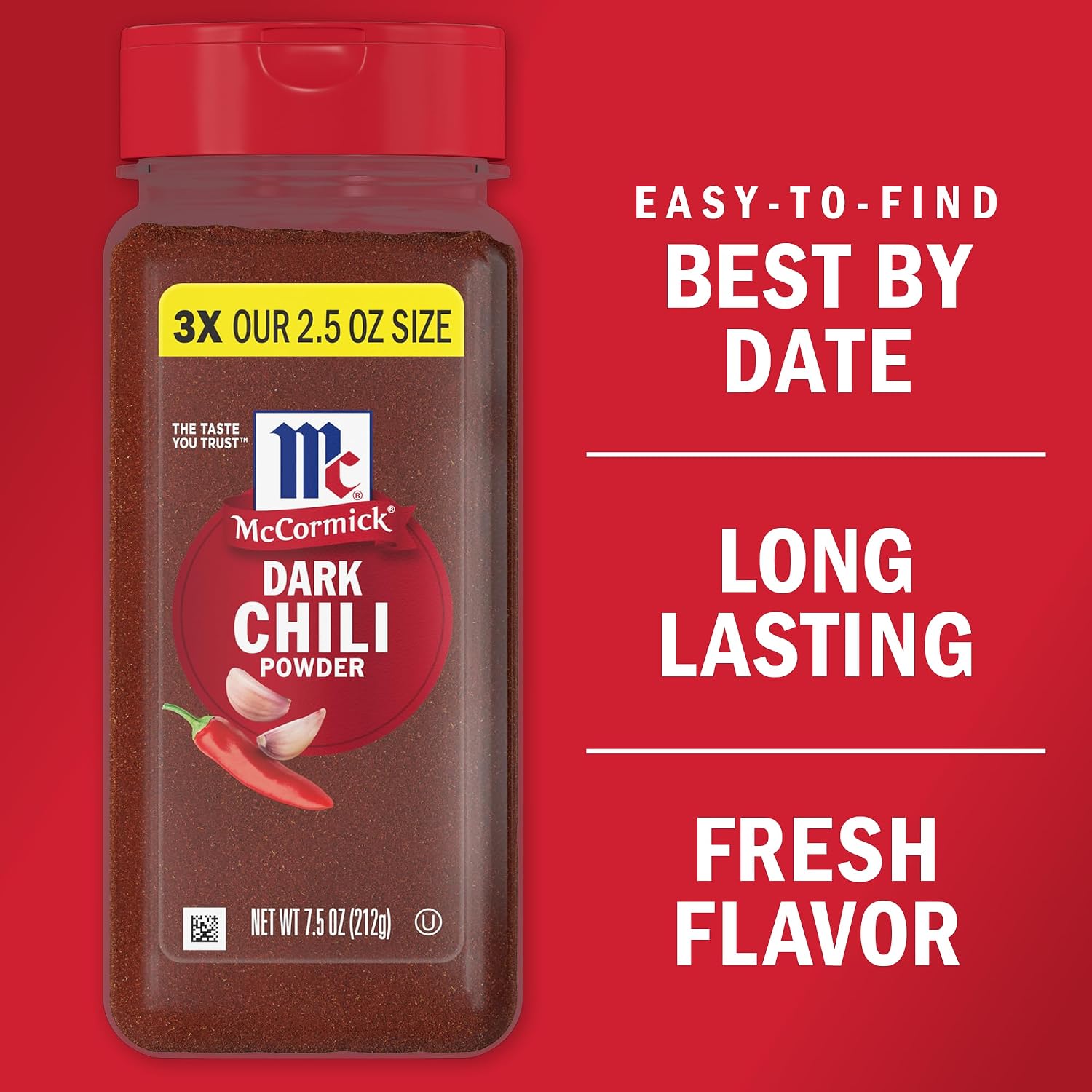
McCormick’s “Dark” designation distinguishes this from their standard blended chili powder. The core difference is the chile base: the Dark formulation leans on darker-roasted, more deeply colored chile varieties, which produce a richer, more complex undertone compared to the brighter, slightly sharper profile of the standard blend. Think of it as the difference between a lightly roasted and a medium-roasted dried chile — same family, different flavor depth.
One flag for certain cooks: McCormick Dark contains sodium. For low-sodium diets, this matters. It also affects how you season your pot — you’re not starting from zero salt when you add this blend, which means your cumulative sodium can climb faster than you expect. Cook’s Illustrated, in their chili powder comparative roundup, flags sodium content as the single most important label detail to read before buying any blended powder, precisely because cooks who don’t read it tend to dramatically over-salt their finished chili.
What consistent buyer feedback praises: the depth of color it lends to the pot, the way it holds up through a long braise without turning bitter, and the way it blooms in hot fat — that is, releases its aromatic compounds quickly and vividly when it hits oil or rendered fat. A blend that blooms well is one whose volatile compounds are still intact, which is a useful freshness proxy when you can’t see a harvest date on the label.
This is the pick for cooks who want consistency above all else. Serious Eats’ chili construction methodology pieces describe how blended powders provide the middle frequencies of flavor — the integrated cumin-oregano-garlic foundation — freeing you to focus on the higher notes with any single-origin additions. McCormick Dark handles that foundational role reliably across long-cook applications: Texas-style braises, competition chili, and slow-cooker builds all benefit from a blend calibrated for depth rather than brightness.
Best for: Long braises, competition-style chili, cooks who prioritize batch-to-batch replicability.
McCormick
$12.20
In stock on Amazon
Check price on AmazonFrontier Co-op Organic Chili Powder
Frontier Co-op’s Organic Chili Powder is the most instructive of the three for an intermediate cook, because it exposes a fundamental truth about spice perception that most recipes don’t bother to explain.
A frequently observed pattern among cooks trying this product for the first time: the powder reads flat out of the jar and under-seasoned in early tasting, then opens up dramatically once salt is properly integrated. This is not a product flaw. It’s an accidental lesson in food science. Salt doesn’t just make things taste salty; it suppresses bitterness and amplifies volatile aromatic compounds. Saveur, in their feature on spice blooming and volatile compound release, explains that many dried spice compounds — particularly those in the capsaicin family and the terpene-heavy oregano fractions — are essentially muted to human perception until sodium ions lower the bitterness threshold enough to let them register. Frontier’s salt-free formulation means you see this effect play out in real time.
The practical implication is that a salt-free chili powder is not worse — it is more sensitive to your seasoning technique. If you already salt in layers (which is how any long-braise chili should be built), Frontier’s blend will perform beautifully. If you season once at the end, you’ll underestimate it every time. Splendid Table has addressed this sodium-perception connection directly in their programming on layered seasoning, noting that cooks who season incrementally throughout a recipe consistently produce more complex-tasting food than those who season at the finish.
Frontier’s organic certification is also meaningful here, not as a marketing claim but as a sourcing signal. Epicurious, in their overview of spice sourcing and blend construction, notes that organic certifications — while not a freshness guarantee — tend to correlate with shorter distribution windows for perishable spice commodities, which improves the odds that what’s in the jar was ground more recently than the average commercial shelf product.
Best for: Cooks who season in layers, low-sodium diets requiring full sodium control, those layering single-origin powders on top of a blend base.
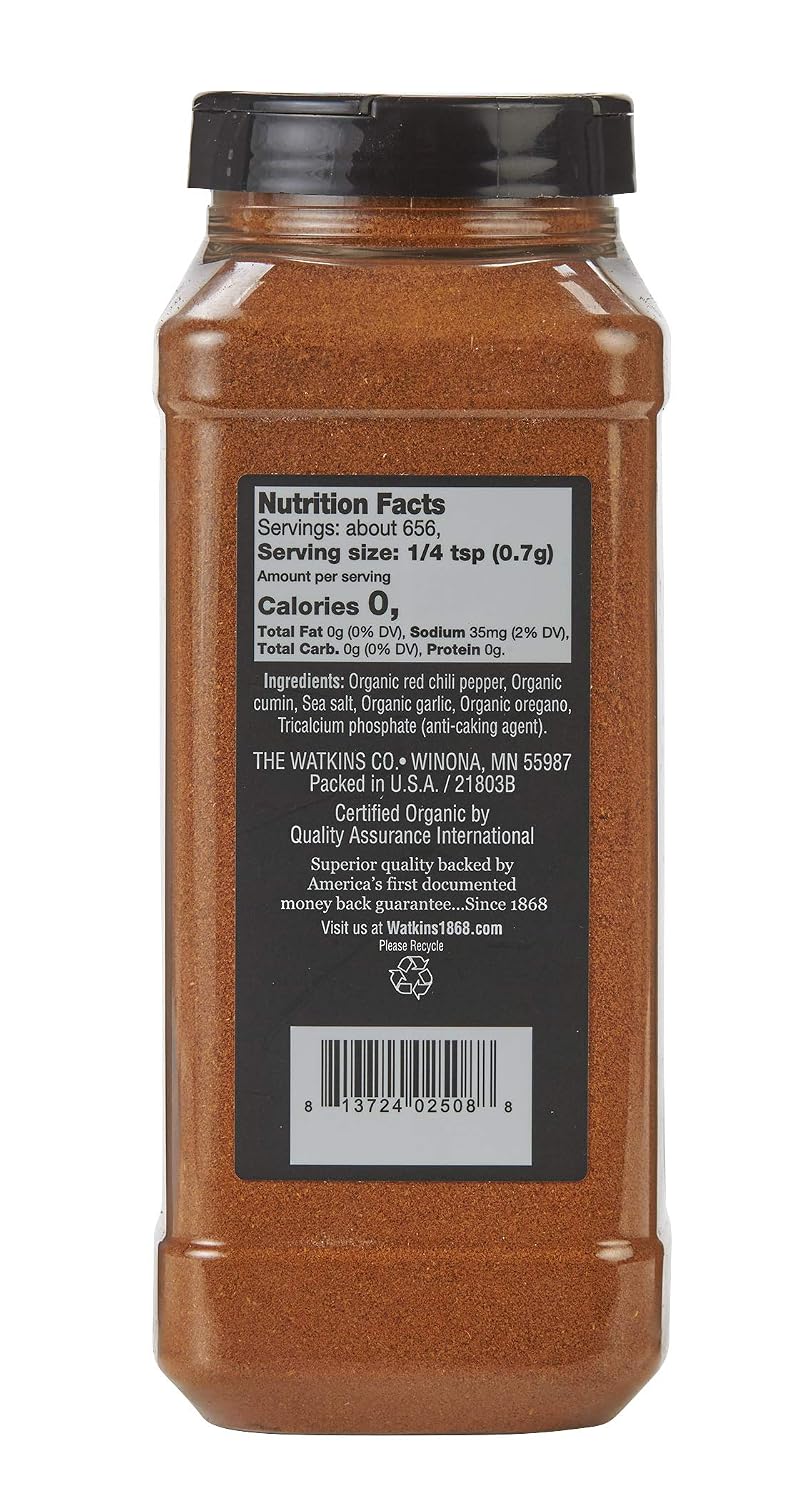
Watkins
$18.99
In stock on Amazon
Check price on AmazonWatkins Chili Powder
Watkins is the most straightforward of the three and the most honest in its market positioning. Buyer observations about it containing “other things besides chili powder” are worth addressing plainly: virtually all commercial chili powders are blends by definition, and Watkins follows the standard formula — ground chile peppers plus cumin, oregano, and garlic, with salt consistent with formulation patterns across this product category.
That’s not a negative disclosure. It’s a reminder that “chili powder” on any label means a blend, not a single-ingredient powder. If you’ve been treating blended powders as pure ground chile, you’ve been adding cumin, garlic, and oregano to your pot without realizing it — which may explain why your ratio adjustments have been harder to dial in. The fix is simple: read the ingredient list on whatever blend you use, then adjust your additional spices accordingly. If your blend already contains cumin and garlic powder, adding more of both on top risks pushing you past the flavor balance you’re after.
Watkins’ buyer sentiment is consistent: owners report a clean, accessible heat level and a flavor that works across a wide range of chili styles without dominating. It reads as a reliable mid-market option rather than a performance leader. Cook’s Illustrated’ comparative spice testing methodology notes that accessibility of heat — neither so mild it disappears nor so aggressive it crowds out other flavors — is one of the primary criteria that separates reliable everyday blends from specialty-use ones.
Best for: Weeknight chili, broad compatibility across chili styles, cooks who want a dependable baseline without strong flavor opinions.
McCormick
$5.08
In stock on Amazon
Check price on AmazonFormulation at a Glance
Understanding formulation differences is what allows you to use any of these blends intentionally rather than interchangeably.
| Product | Contains Salt | Contains Cumin | Contains Garlic | Organic Certified | Best Application |
|---|---|---|---|---|---|
| McCormick Dark | Yes | Yes | Yes | No | Long braises, competition chili |
| Frontier Co-op Organic | No | Yes | Yes | Yes | Layer-seasoned builds, low-sodium |
| Watkins | Yes (likely) | Yes | Yes | No | Weeknight, broad use |
Can You Use a Blend Alongside Single-Origin Powders?
Yes, and it’s often the smarter move than choosing between them. The practical approach: use a blended powder as your backbone — the cumin-oregano-garlic integration is already done — then reach for single-origin powders to build complexity on top. A pure ancho adds fruitiness. A pure guajillo adds brightness. A pure chipotle adds smoke. The blend handles the infrastructure; the single-origin additions handle the distinctive character.
Serious Eats’ chili methodology pieces describe this layering approach consistently, noting that blended powders occupy the middle frequencies of flavor while single-origin additions handle the high notes. If you use Frontier’s salt-free blend as your base, you have full control over sodium as you add those single-origin layers — the most technically clean version of this approach.
One constraint worth naming: if your blend already contains significant cumin and garlic powder, be conservative with additional amounts of both. Over-cumin-ing a chili is a common intermediate mistake, and blended powders make it easy to get there without realizing how much you’ve already added. Epicurious’ spice-blend guidance recommends tasting the blend in a small amount of hot fat before committing to quantity — you’ll immediately understand what’s already present and what the dish still needs.
Frequently Asked Questions
What is the difference between McCormick regular chili powder and McCormick Dark? The standard McCormick blend uses a lighter chile base, producing a brighter, sharper flavor with more immediate heat. The Dark formulation uses deeper-roasted chile varieties, producing more color, more toasted-pepper complexity, and a slightly earthier finish. Both contain sodium and the standard blend additions. The Dark version is better suited for long braises and competition-style chili; the standard blend performs better in quick applications where you want heat presence without deep earthiness.
Is salt-free chili powder actually better for cooking, or does it just taste flat? It’s not inherently better or worse — it’s more technique-dependent. Salt-free blends like Frontier’s require deliberate, layered seasoning, which is the correct approach anyway. The flat experience some cooks notice is a seasoning deficit, not a product deficiency. Season properly and it blooms. For low-sodium cooks, salt-free is unambiguously the better choice because it provides full control over sodium input throughout the cook.
How much chili powder should you use per pound of meat in a 6-quart pot? A reasonable starting range is 1 to 1.5 tablespoons of blended chili powder per pound of meat. For a 6-quart pot with 3 pounds of meat, that’s 3 to 4.5 tablespoons of blend as your base — then taste and adjust after the first 20 minutes of simmer. If you’re layering single-origin powders on top of a blend, start at the lower end and build from there.
Can you combine a blended chili powder with single-origin powders in the same recipe? Absolutely, and it’s often the most efficient path to complexity. Use the blend as your base and add single-origin powders — pure ancho, guajillo, or pasilla — to push specific flavor notes. Watch your cumulative cumin and garlic if your blend is already well-loaded with both.
How long does an open container of blended chili powder stay potent? Cook’s Illustrated’ spice storage guidance puts the practical window at 12 to 18 months for an opened container stored in a cool, dark, airtight location. The real test is the bloom test: put a pinch in hot fat. If the aroma is immediate and vivid, the powder is still live. If it takes more than 30 seconds to register, the volatile compounds have dissipated and you’ll need to use significantly more — or replace it.
The Decision Rule
Here’s where this lands for the intermediate cook:
- Consistency and replicability above all: McCormick Dark is the pick. Acknowledge the sodium, build your recipe around it, and don’t apologize for using it.
- Maximum control and technique-forward cooking: Frontier Co-op Organic is the more technically elegant choice. The salt-free formulation rewards layered seasoning and leaves room for clean single-origin additions.
- Reliable everyday workhorse: Watkins fills that role without strong opinions in either direction — accessible, broad-compatible, and consistent.
- Building toward scratch: Use any of these blends as your base while you develop your single-origin additions alongside them. The blend doesn’t disappear from your shelf as your spice collection grows — it just plays a more defined role.
The scratch-cook assumption that building your own is always better is mostly correct. But mostly isn’t always. A calibrated blend, used with intention, is a tool — not a compromise.