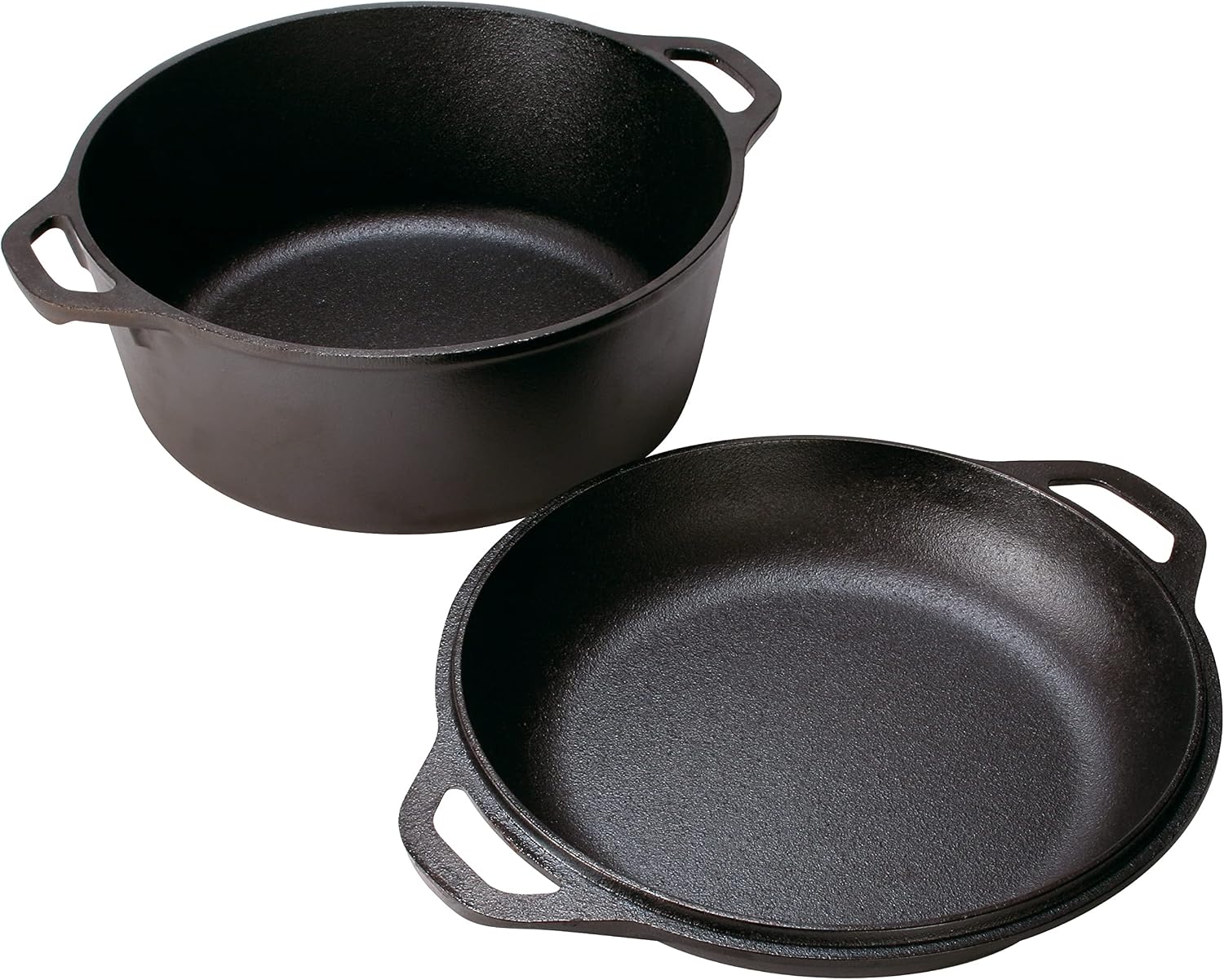
If you’ve started taking chili seriously — spending real time building flavor with dried chiles, sweating aromatics low and slow, browning meat in proper stages — you’ve probably been told to invest in a good Dutch oven. A Dutch oven is simply a heavy pot with a tight-fitting lid, designed to hold and distribute heat evenly for long braises and stews. The enameled versions (Le Creuset, Staub, Lodge’s own enameled line) are the most talked-about, and for good reason: the smooth interior is naturally non-reactive, easy to clean, and won’t pick up flavors between cooks. But bare, uncoated cast iron — the kind your grandmother might have pulled off a hook in her kitchen — is a different animal entirely, and it has a legitimate, underexplored place in a chili cook’s rotation. This article is about when bare cast iron makes sense, when it doesn’t, and what you actually get when you buy Lodge’s pre-seasoned line in the $40–$80 range.
| EDITOR'S PICK[Lodge Seasoned Cast Iron Camp D…](https://www.amazon.com/dp/B0009JKG92?tag=greenflower20-20) | Mid-tier[Lodge Cast Iron Dutch Oven 7 Qu…](https://www.amazon.com/dp/B000SOM5XS?tag=greenflower20-20) | Budget pick[Lodge Cast Iron Double Dutch Ov…](https://www.amazon.com/dp/B00063RWYI?tag=greenflower20-20) | |
|---|---|---|---|
| Capacity | 6 qt | 7 qt | 5 qt |
| Pre-seasoned | ✓ | — | ✓ |
| Lid type | Steel handle | Loop handle | 2-in-1 skillet |
| Oven-safe | — | ✓ | ✓ |
| Price | $79.99 | $79.90 | $59.90 |
| See on Amazon → | See on Amazon → | See on Amazon → |
The Real Difference Between Bare and Enameled Cast Iron
The term “enameled” means the raw iron has been coated with a layer of fused glass (the enamel). That coating is what makes Le Creuset or a Lodge enameled Dutch oven look matte-black or vibrant red, and it’s what protects the iron from moisture and acidic ingredients. Beneath that coating, both types of pot are fundamentally the same material: heavy cast iron with excellent heat retention and even heat distribution once fully up to temperature.
Strip that coating away and you have bare cast iron. The cooking surface is raw iron, protected only by seasoning — layers of polymerized oil baked into the metal over time. Lodge’s pre-seasoned pots arrive with a factory seasoning already applied, so you’re not starting from zero, but you are starting from a surface that behaves very differently from enamel.
Why this matters for chili specifically:
Chili is an acidic cook. Tomatoes, dried chiles rehydrated in water, even certain beer additions — all of these lower the pH of your braise. Prolonged contact between acidic liquid and bare iron does two things: it can strip seasoning over time, and it can impart a faintly metallic flavor to the finished dish, particularly in long-cook chilis (three hours or more). Serious Eats’ Dutch oven equipment review notes that bare cast iron is generally best suited for high-heat applications and dry cooking rather than acidic braises.
That said, “can happen” and “will ruin your pot of chili” are not the same sentence. The threshold for noticeable flavor impact is meaningful exposure over long periods — and the practical tradeoffs run in both directions.
Where Bare Cast Iron Earns Its Place in a Chili Kitchen
The case for bare cast iron is strongest in two specific chili-adjacent scenarios:
1. The initial sear and fond-building phase. Many serious chili cooks separate their cook into stages: a hard sear for meat and onions over high heat, then a long braise at lower temperature. Bare cast iron handles the high-heat stage better than enameled iron in one key respect — you can take it higher without worrying about thermal shock to the enamel surface. Cook’s Illustrated’s cast iron Dutch oven review has noted that bare surfaces also tend to build a darker, more aggressive fond (the browned bits that stick to the bottom and dissolve into the sauce for flavor depth) than enameled surfaces, which are slightly more slick. If you’re doing a two-vessel cook — sear in bare cast iron, braise in enameled — that combination plays to each pot’s strengths.
2. Camp and outdoor cooking. Bare cast iron is essentially indestructible in outdoor conditions. You can set it directly into coals, use it over a propane burner at high heat without any of the babysitting that enamel requires, and not worry about chipping a $300 pot. For competition cooks doing outdoor events or anyone doing overnight campfire chilis, Lodge’s bare Dutch ovens with the legs and flanged lid (designed for coal cooking) are purpose-built for that use case in a way that a Le Creuset simply is not.
What Lodge’s Pre-Seasoned Line Actually Delivers
Lodge is the default recommendation in this price tier, and with good reason — they’ve been casting iron in South Pittsburg, Tennessee since 1896 and are the only remaining major cast iron manufacturer producing in the United States. Their pre-seasoned Dutch ovens run $40–$80 depending on size (the 5-quart and 7-quart are the most relevant for chili), and they arrive with a factory-applied vegetable oil seasoning.
By the numbers:
| Model | Size | Weight | Street Price (May 2026) |
|---|---|---|---|
| Lodge Pre-Seasoned Dutch Oven | 5 qt | ~12 lbs | ~$45–$55 |
| Lodge Pre-Seasoned Dutch Oven | 7 qt | ~15 lbs | ~$60–$80 |
| Lodge Camp Dutch Oven (legs + flanged lid) | 6 qt | ~14 lbs | ~$55–$70 |
Owners consistently report that the factory seasoning is functional but thin — adequate for getting started, but noticeably rougher to the touch than a well-seasoned family heirloom pan. Wirecutter’s Dutch oven buying guide reflects this, noting that Lodge’s pre-seasoned cookware improves substantially with use and additional seasoning passes, and that its performance gap relative to enameled competitors narrows considerably after six to twelve months of regular cooking.
The practical implication: if you buy a Lodge bare Dutch oven and cook your first big batch of chili in it with a full tomato load, you may notice a slight metallic edge. If you use the same pot for a few months of higher-heat cooking — searing, cornbread, roasting — before running it through a long acidic braise, you’re working with a meaningfully more resilient surface.
Food52’s guide to cast iron care makes the useful distinction that seasoning isn’t a one-time event but an ongoing accumulation. Each cook that isn’t acidic or prolonged-wet adds to the polymerized oil layer. Each acidic long-braise draws it down slightly. The goal is to keep the balance positive.
Apartment Therapy’s Lodge vs. Le Creuset comparison is direct about the positioning: Lodge’s bare line wins on price-to-performance for cooks who will put in the seasoning work or who primarily use the pot for applications other than acidic braises. It loses on convenience, especially for anyone who cooks tomato-heavy chili weekly and doesn’t want to maintain a seasoning schedule.
The Honest Tradeoff Matrix
Here’s where most buying-guide articles soft-pedal the real decision. Let’s name the tradeoffs explicitly:
Bare cast iron (Lodge pre-seasoned) wins when:
- You’re splitting your cook across vessels (sear in bare iron, finish in enameled or stainless)
- You’re cooking outdoors, over coals, or in conditions where you’d be nervous about chipping enamel
- You want a generalist pot that does cornbread, whole chicken, and cast iron-specific techniques, not just chili
- Your budget is under $80 and you’re willing to invest time in the seasoning curve
- You’re building a competition setup and need a dedicated high-heat sear vessel
Enameled cast iron wins when:
- Your chili is tomato-forward and cooks for 2–4 hours at temperature
- You want zero maintenance overhead between cooks
- You’re gifting the pot or buying for someone who won’t invest in seasoning care
- You’re doing bean-forward or broth-heavy chilis where a clean, neutral surface matters
The scenario where the choice is closest: A Texas-style no-bean beef chili that uses dried chiles rehydrated separately (so the acidic contact is lower) and cooks for 90 minutes to two hours. In this case, a well-seasoned Lodge bare Dutch oven performs closer to its enameled equivalent than most comparisons acknowledge. The dried chile approach — reconstituting guajillos and anchos in separate water, then blending the soaked chiles into a paste — keeps the overall acidity of the braising liquid significantly lower than a recipe built on canned crushed tomatoes. That changes the calculus.
Building the Decision Rule
If you’re buying your first Dutch oven specifically for chili: buy enameled. The Lodge enameled line at $50–$80 (same price tier as the bare version) gives you a non-reactive surface that handles every chili format without a learning curve. The Wirecutter guide consistently points to Lodge’s enameled Dutch oven as the best value pick in that tier, and the editorial consensus across Serious Eats and Cook’s Illustrated supports that positioning.
If you already own an enameled Dutch oven and are asking whether bare cast iron adds something: yes, specifically for the sear stage and outdoor cooking. A Lodge pre-seasoned 5-quart at $45–$55 as a second vessel makes genuine sense at that price.
If you’re a competition cook building a camp-legal outdoor setup: the Lodge Camp Dutch Oven with legs and flanged lid is purpose-built for coal cooking in a way that nothing else in this price tier is, and it’s worth buying on that basis alone.
The decision rule, plainly stated:
If your primary chili format is tomato-heavy and long-cooked → enameled, full stop. If you’re splitting the cook, cooking outdoors, or adding a sear vessel → bare Lodge is a real and efficient choice. If you’re starting from zero with no other cast iron → buy enameled first, add bare later if the use case develops.
The gap between “good enough” and “pro-grade” in cast iron cookware is real, but it bends at a different place than most people expect. For chili specifically, the enamel coating is doing meaningful work in a way that justifies its cost — until the moment you’re outside over live fire, at which point bare iron is the only sensible answer. Know which cook you’re running, and the right pot becomes obvious.