If you’ve ever shaken a generic bottle of “chili powder” into a pot and wondered why the results tasted flat — you’re not alone, and the answer is almost certainly in what’s actually inside that jar. Most commercial chili powders are blends: dried ground chile peppers mixed with cumin, garlic powder, and sometimes salt, calibrated for broad appeal rather than flavor depth. Single-varietal chile powders, by contrast, are made from one specific type of dried chile — an ancho (a dried poblano, carrying dark fruit and mild heat), a guajillo (with its bright, cranberry-like tartness), or a chipotle (smoked dried jalapeño, with that familiar campfire warmth) — each one bringing a distinct profile that you can dial up or down intentionally. A curated chile powder collection, the kind worth giving or receiving as a gift, teaches you to think in those distinct voices rather than reaching for a single blended shortcut. This guide breaks down what separates a genuinely educational chile powder set from a pretty box of redundant powders — and names the specific collections worth your money in 2026.
What Makes a Chile Powder Set Actually Educational
The bar here is specific. A set earns the “teaches something” label only if it exposes you to meaningfully different flavor categories — not five variations on the same smoky-mild profile. Think of it like a wine flight versus five glasses of the same varietal: the comparison is where the learning happens.
Serious Eats’ guide to chili powders identifies three broad flavor axes that matter for chili building: heat level (mild to incendiary), fruitiness (dried berry notes in ancho and mulato versus the sharper brightness of guajillo), and earthiness or smokiness (the roasted, tobacco-adjacent depth of pasilla versus the wood-smoke hit of chipotle). A set that spans all three axes gives you the vocabulary to actually compose a chili rather than follow a recipe blindly.
Here’s the tradeoff that most gift sets get wrong: they optimize for visual presentation — uniform jar sizes, matching labels, photogenic reds — instead of flavor range. You end up with ancho, mild New Mexico red, and California red, which are all in the same dark-fruity, mild-heat neighborhood. They look like a collection. They don’t function like one.
By the numbers — the flavor spread worth looking for:
| Category | Example varietals | What it adds to chili |
|---|---|---|
| Dark & fruity | Ancho, mulato, pasilla | Base richness, low heat |
| Bright & acidic | Guajillo, New Mexico (hot) | Clarity, tartness, mid-heat |
| Smoky | Chipotle, morita | Depth, char, warmth |
| High heat | Arbol, cayenne, pequin | Top-end spike, forward bite |
A set that hits at least three of these four categories is a set that teaches layering. Two or fewer and you’re just buying redundancy.
The Sets Worth Buying (and Why Each One Works)
Penzeys Chili Powder Sampler Tier
Penzeys — a Madison, Wisconsin spice company with a long track record among home cooks — publishes clear varietal descriptions on every product page, which matters more than most buyers realize. When you’re learning, the label copy is part of the lesson. Their individual chile powders (ancho, chipotle, guajillo, and arbol among others) can be assembled into a custom sampler, and the company periodically offers gift sets that bundle four to six of these in smaller-format tins.
The Penzeys case for a gift set: it’s approachable price-wise (individual 1–2 oz jars typically run $5–$9, making a curated four-pack a sub-$40 gift), the quality is consistent and well above grocery-store baseline, and the flavor gap between their ancho and their chipotle is dramatic enough to be immediately instructive. Per Penzeys’ own catalog descriptions, their chipotle is specifically meco-style — a longer-smoked, drier preparation with a more tobacco-forward profile than the morita chipotles you find in adobo — which is useful context for someone learning the difference.
The honest limitation: Penzeys sources at scale, which means you’re not getting harvest-dated, single-origin material. The powders are clean and well-balanced, but they don’t carry the terroir specificity that the next tier delivers.
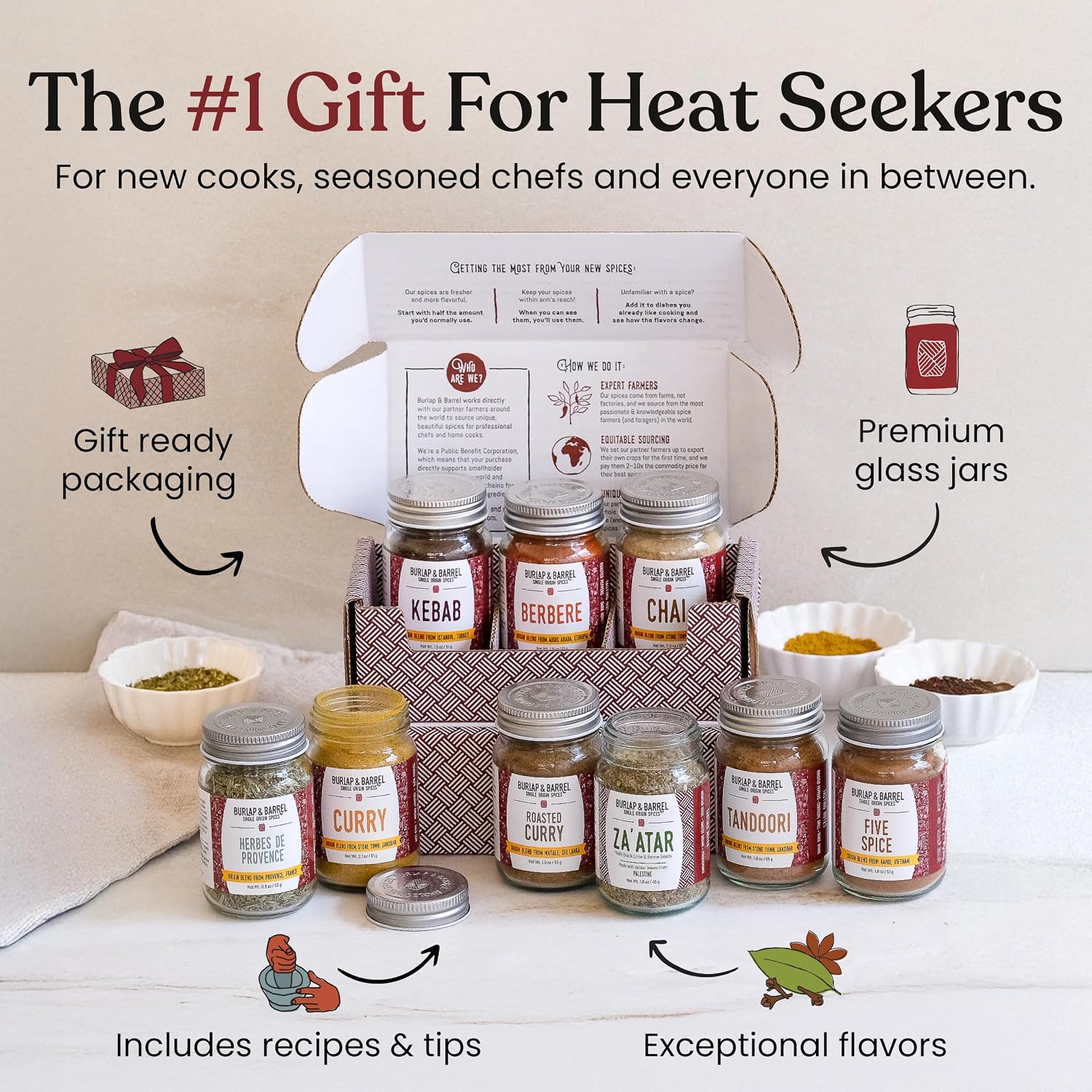
Burlap & Barrel Single-Origin Chile Powder Collections
Burlap & Barrel, a New York-based single-origin spice company, operates closer to the specialty-coffee sourcing model than the traditional spice trade — direct relationships with small farms, published origin information, and seasonal or limited-availability releases. Their chile offerings as of 2026 include a Royal Blush paprika from Serbia, a Urfa biber (a Turkish dried chile with fruity, raisin-like depth and mild heat), and rotating New World varietals that have included ancho, guajillo, and arbol in dried and powdered form.
Why this tier teaches something different: the Urfa biber alone is a paradigm-shift ingredient for a chili cook accustomed to North American chile taxonomy. Food52’s guide to dried chiles describes Urfa as having “an oily, almost chocolatey quality” — which tracks with Burlap & Barrel’s own tasting notes and with what dedicated users report across aggregated reviews. Adding it to a chili alongside a guajillo creates a flavor complexity that a single-region sampler simply can’t replicate.
The tradeoff: Burlap & Barrel doesn’t always package these as pre-curated gift sets — you may be assembling the collection yourself. That actually makes it a better gift for someone who’s ready to direct their own education, less ideal for someone who wants a clean unboxing experience. Budget roughly $12–$18 per small jar; a four-item curated selection lands at $50–$70.
Rancho Gordo Chile & Spice Sets
Rancho Gordo, best known for their heritage dried beans, also carries a focused selection of whole dried chiles and ground chile powders sourced with the same provenance standards they apply to their bean program. Their chile powder offerings tend toward the New World canon — ancho, guajillo, pasilla negro — with an emphasis on Mexican regional varieties and harvest transparency.
What sets Rancho Gordo’s offering apart for an intermediate cook is the combination of whole-chile and ground options. If a set includes both a whole dried ancho and an ancho powder, you can grind your own batch in a spice grinder and compare it directly to the commercial grind — an exercise that Splendid Table’s coverage of chile technique consistently points to as one of the fastest ways to develop a chile palate. The texture of a just-ground chile is different: more volatile aromatics, slightly coarser, with a freshness that pre-ground can’t match.
Rancho Gordo’s gift sets (which appear seasonally and sell out quickly — the Napa, California company runs a Rancho Gordo Bean Club with similar scarcity mechanics) typically run $45–$85 depending on included items. The honest gap: their chile powder selection is smaller than Penzeys or Burlap & Barrel, so you may hit the flavor-range ceiling faster. The case for them is provenance and the whole-chile teaching opportunity, not breadth.
What to Skip (and Why the Pretty Box Isn’t the Point)
The gift sets most likely to disappoint are the big-box or e-commerce private-label collections: four to six matching tins with generic “chili blend,” “smoky seasoning,” “taco spice,” and one actual varietal thrown in for credibility. These are optimized for shelf presence and gift-wrapping aesthetics. They are not optimized for learning.
Saveur’s guide to dried chiles notes that the single biggest variable in chile powder quality is how recently the chiles were ground — oils and volatile aromatics degrade significantly over six to twelve months post-grinding. Private-label gift sets sitting in a warehouse for months before reaching a gift shop cannot compete on freshness with direct-from-spice-company orders, regardless of how the packaging looks.
The other thing to skip: any set that doesn’t name varietals on the label. “Mild red chile powder” tells you nothing. “Ancho (dried poblano), ground from 2025 harvest” tells you something useful. If the producer isn’t confident enough in their sourcing to name what’s in the jar, treat that as a red flag.
The Decision Frame: Which Set Fits Which Buyer
If X, then Y:
If the recipient is a serious home cook who already knows ancho from guajillo — build a Burlap & Barrel set around their less-familiar varietals (Urfa biber, a smoked paprika with unusual terroir, one high-heat arbol or arbol-adjacent option). The education is in the unfamiliar, not the familiar. Budget $55–$75 assembled.
If the recipient is intermediate and wants a structured on-ramp to single-varietal cooking — a Penzeys four-pack spanning dark-fruity (ancho), bright (guajillo), smoky (chipotle), and hot (arbol) is the most cost-efficient path to a complete flavor vocabulary. Under $40, clean presentation, detailed label copy. This is the set I’d recommend first.
If the recipient is competition-track or sourcing-obsessed — Rancho Gordo’s seasonal set plus a bag of their whole dried chiles for grinding practice. The provenance documentation and the whole-chile option make this a working tool, not just a pantry decoration. This is also the strongest gift for someone who already owns a Zassenhaus or Peugeot grinder and isn’t using it for chiles yet.
If the budget is over $80 and you want maximum range — combine: one Burlap & Barrel unusual-varietal (Urfa or their current rotating selection), two to three Penzeys single-varietals to fill the North American canon, and a Rancho Gordo whole dried ancho for the grinding exercise. You’ve now covered three sourcing philosophies, four flavor categories, and two preparation methods. That’s a curriculum.
The through-line across all of these: the gift set that teaches something is the one that creates comparison. One jar of one powder is a seasoning. Four jars of four distinct varietals with clear labeling is an education. The goal is to put a cook in a position where they’re making decisions — reaching for guajillo when they want brightness, ancho when they want body, chipotle when they want smoke — rather than just shaking the same bottle every time. That decision-making muscle is what separates a chili that’s consistently good from one that’s intentionally composed, and a collection that spans the flavor map is the fastest way to build it.