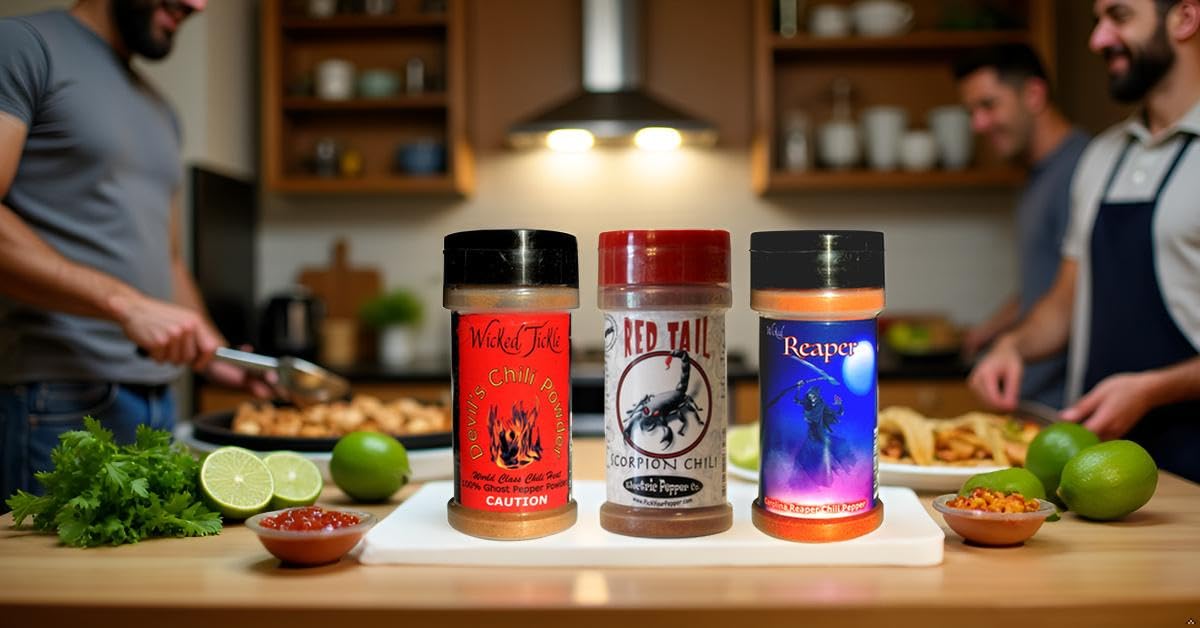
You already know the difference between a poblano and an ancho. You’ve built a spice shelf with some intention behind it, and you’ve probably cooked a chili that you were genuinely proud of. Now you’re standing in front of a small jar — ghost pepper powder, scorpion powder, or Carolina Reaper powder — and you’re wondering whether adding any of it to your pot is a craft decision or a liability. The answer is: both, depending almost entirely on how much you add and when. These powders are measured in millions of Scoville Heat Units (SHUs — a standardized scale where jalapeño peaks around 8,000 and Carolina Reaper averages above 2 million), and they behave in a chili differently than any chile you’ve worked with before. This guide is about the tradeoffs, the math, and the specific techniques that let you use extreme heat powders as a flavor tool rather than a hazard.
The Flavor Case: Why Extreme Heat Powders Aren’t Just Heat
The single most important thing to understand before you open the jar is that the top-tier superhot peppers — ghost (bhut jolokia), Trinidad moruga scorpion, and Carolina Reaper — all carry distinct flavor profiles that survive into a finished chili, if you dose correctly. Buyers of Wicked Reaper powder, one of the better-known superhot blends on the market, consistently note that at responsible doses they detect sweet and floral notes that have nothing to do with the burn. The heat is there, but so is character. Reviewers of Wicked Tickle’s three-pepper set — a sampler format that includes ghost, scorpion, and reaper — describe each pepper as producing a distinctly different physical sensation across “mouth, ears, nose, and throat,” which is actually a useful flavor-map for the chili cook: ghost hits primarily at the back of the throat and builds slowly; scorpion tends to be an immediate, broad-surface heat with a fruity sharpness; reaper is the longest-sustained and most diffuse, often described as carrying a slight sweetness before the heat escalates.
Per Chili Pepper Madness’s coverage of the Scoville scale, these aren’t just hotter jalapeños — they’re chemically different in their capsaicinoid profiles, which is part of why the heat onset and fade feel so different from one to another. That distinction matters in a long-simmered chili where the fat, acid, and protein in the pot will interact with each capsaicinoid differently over time.
The practitioner tradeoff to name explicitly: flavor extraction and heat management are in direct tension. Lower doses let the floral and fruity notes come through. Higher doses overwhelm those notes entirely and make the bowl about endurance rather than craft. Your job is to find the dose where the pepper contributes flavor, not just pain.
The Dosing Math: Starting Points That Actually Work
Here’s the number that should anchor your first cook with any of these powders: ½ teaspoon per 2 cups of liquid is the calibration point reported by experienced Wicked Reaper buyers as a baseline where flavor is detectable and heat is significant but manageable for most adults who eat spicy food regularly. Scale that up to a standard 6-quart pot of chili — which typically contains somewhere between 4 and 6 cups of liquid between your base, your tomatoes, and your broth — and you’re looking at a 1 to 1½ teaspoon ceiling for the whole pot before you’ve gone past “hot” into “punishing.”
By the Numbers
| Pot size | Liquid volume (approx.) | Ghost or Scorpion — starting dose | Reaper — starting dose |
|---|---|---|---|
| 4-qt | 3–4 cups | ¼ tsp | ⅛ tsp |
| 6-qt | 4–6 cups | ½ tsp | ¼ tsp |
| 8-qt | 6–8 cups | ¾ tsp | ⅜ tsp |
These are conservative first-cook numbers. They’re not the ceiling — they’re the place to start when you don’t yet have a calibration baseline for a specific powder’s potency, which varies by batch, crop year, and grind fineness. Superhot powders from Wicked Tickle reviewers note the set lasts “months and months if not an entire year” even at frequent use because the dosing is measured in fractions of teaspoons. That longevity also means the cost-per-use math is genuinely favorable compared to fresh superhot peppers, which are seasonal, harder to source, and require significantly more prep infrastructure.
Timing and Technique: When to Add, How to Bloom, and What the Simmer Does
The most common mistake practitioners make with extreme heat powders isn’t the dose — it’s adding them dry, early, and directly to fat. Here’s why that’s a problem:
The blooming question. Blooming fat-soluble spices in oil is standard technique for most chili powders (ancho, guajillo, pasilla — all benefit from 60–90 seconds in hot fat). The logic is sound for those peppers because their heat level is manageable even if you accidentally over-extract. With superhot powders, fat blooming dramatically accelerates capsaicin extraction, which means the margin for error shrinks to almost nothing. A half-teaspoon of reaper powder that hits 375°F fat for 90 seconds in a standard Dutch oven is going to fully mobilize in a way that makes the finished heat level extremely difficult to predict or correct.
The recommended approach — supported by technique guidance from Serious Eats’ coverage of capsaicin chemistry — is to add extreme heat powders in a liquid suspension, not directly to fat. Dissolve your measured dose in 2–3 tablespoons of your simmering chili liquid before stirring it back into the pot. This gives you control, distributes the powder evenly, and prevents hot spots where a concentrated pocket of capsaicin can create an uneven heat experience in the finished bowl.
Early vs. late addition — the actual tradeoff:
- Early addition (first 30 minutes): The heat mellows very slightly over a long simmer, but not dramatically. Capsaicin is heat-stable; it doesn’t cook off in any meaningful sense, per Serious Eats’ food-science coverage. What changes is integration — the heat becomes more woven into the overall flavor rather than sitting on top. If flavor complexity is your goal, early addition is correct, at the low end of your dose.
- Late addition (last 15 minutes): Heat is brighter and more immediate at the table. The floral and fruity notes from ghost and reaper are more detectable because they haven’t had time to diffuse into the fat. If you want the pepper’s character to be identifiable, hold a portion for late addition.
The hybrid approach that works well: Add 70% of your intended dose early — dissolved in liquid — and reserve 30% for a late addition. This gives you both integration depth and aromatic brightness, and it gives you a check-in point to taste before you commit the full dose.
The Entry Point Argument: Why Arbol Before Reaper
There’s a vivid piece of calibration that circulates among buyers who’ve jumped directly from mild chili powders to the superhot tier: a reviewer who had previously used Carolina Reapers and scorpions describes the consequences of poor dose calibration graphically — specifically, lying on the bathroom floor. This is not an edge case. The gap between “I can eat spicy food” and “I can cook responsibly with 2-million-SHU powder” is real, and it’s primarily about dose intuition built through experience.
Chile de Arbol — a dried chile that runs around 15,000–30,000 SHU, roughly the heat of a serrano — is the right entry point for building that intuition before you open the superhot jar. Saveur’s coverage of dried chile applications in chili consistently positions arbol as the bridging chile: it’s hot enough that you have to think about dosing, it contributes a specific dry, smoky, nutty heat that reads differently than chili powder blends, and it teaches you how heat disperses in a long simmer at a scale that’s recoverable if you overshoot. Get a dozen arbol-based chilis right before you move to ghost. That isn’t caution for its own sake — it’s intuition-building that makes you a better practitioner with the more expensive and more volatile powders.
Rescue Protocol: How to Pull Back a Bowl You’ve Overshot
You added too much. It happens. Here’s the decision tree:
Option 1 — Dilute: Add more unseasoned base (additional broth, more tomatoes, more cooked beans). This is the cleanest fix. It works, it’s reversible, and it doesn’t fundamentally alter the bowl’s character if you add the right components.
Option 2 — Fat addition: Stirring in a tablespoon or two of lard, butter, or coconut cream disperses capsaicin into additional fat molecules and makes the heat feel less immediate. Epicurious’s coverage of dairy and fat as capsaicin mitigation agents confirms that capsaicin binds to fat — adding fat doesn’t reduce the capsaicinoid load, but it distributes it differently and changes the perceived intensity at the table.
Option 3 — Dairy at serving: Sour cream, Mexican crema, or a yogurt-based garnish at the table is not a fix for an overheated pot — it’s a palate reset between bites. It works at the level of individual mouthfuls by providing casein (a milk protein) that physically binds capsaicin molecules before they reach pain receptors. Per Epicurious’s food-science reporting, casein is meaningfully more effective than water or starch. What it isn’t: a systemic correction for a pot that’s too hot. Use it at the serving stage, not as a rescue for the batch.
Option 4 — Starch additions: Adding masa, cornmeal, or additional beans thickens the bowl and somewhat distributes heat, but the effect is modest. This is a supporting move, not a primary fix.
Safe Handling: The Non-Negotiable Basics
Superhot powders aerosolize during handling. This is not metaphor — the fine particulate from reaper or ghost powder becomes airborne the moment you open the bag, and capsaicin in the airway is a different experience than capsaicin on the palate.
- Gloves: Nitrile kitchen gloves for measuring and any contact with the powder directly. Even a small amount transferred from fingers to eyes is a significant problem.
- Ventilation: Open the container away from your face, at arm’s length. If you’re measuring indoors, ensure you have ventilation moving away from your work area.
- Dedicated measuring spoon: Wash immediately after use, separately from other utensils if anyone else in your household is sensitive to heat.
- Children and pets: Extreme heat powders stored at counter height in an accessible jar are a legitimate safety concern. Treat them like you would a cleaning chemical in terms of storage.
Frequently Asked Questions
How much ghost pepper powder should I add to a 6-quart pot of chili? Start at ½ teaspoon dissolved in chili liquid. Taste at 30 minutes. The table above gives you the scaling logic — stay at the lower end until you’ve built calibration with the specific powder you’re using.
Can I taste the flavor difference between ghost, scorpion, and Carolina Reaper in a finished chili, or is it just heat? At low doses, yes — reviewers of multi-pepper sets like Wicked Tickle consistently report distinct flavor differences between each variety. At high doses, the heat dominates and the flavor differences compress. Keep the dose low if you want the character of the specific pepper to read in the finished bowl.
How do I reduce the heat in a chili after I’ve added too much extreme pepper powder? Dilute with additional unseasoned base first (broth, tomatoes, beans). Then consider a fat addition to redistribute capsaicin. Serve with crema or sour cream at the table for per-bite relief. There’s no method that removes capsaicin from the pot — only dilution and redistribution work.
Should extreme heat powders go in at the beginning or end of a long simmer? Both, ideally — 70% early for integration, 30% late for brightness. If you’re choosing one, early addition in liquid suspension produces the most even, predictable result.
What is the safest way to handle ghost and reaper powders without skin or eye irritation? Nitrile gloves, arm’s-length opening, ventilated workspace, dedicated measuring spoon washed separately. Treat it as a concentrated substance, not a pantry spice.
How do extreme heat powders interact with dairy cooling agents like sour cream in the finished bowl? Casein in dairy proteins physically binds capsaicin molecules, which is why dairy is more effective than water at reducing perceived heat. Sour cream and crema work as per-bite relief at the table, not as a batch-level fix for an overheated pot.