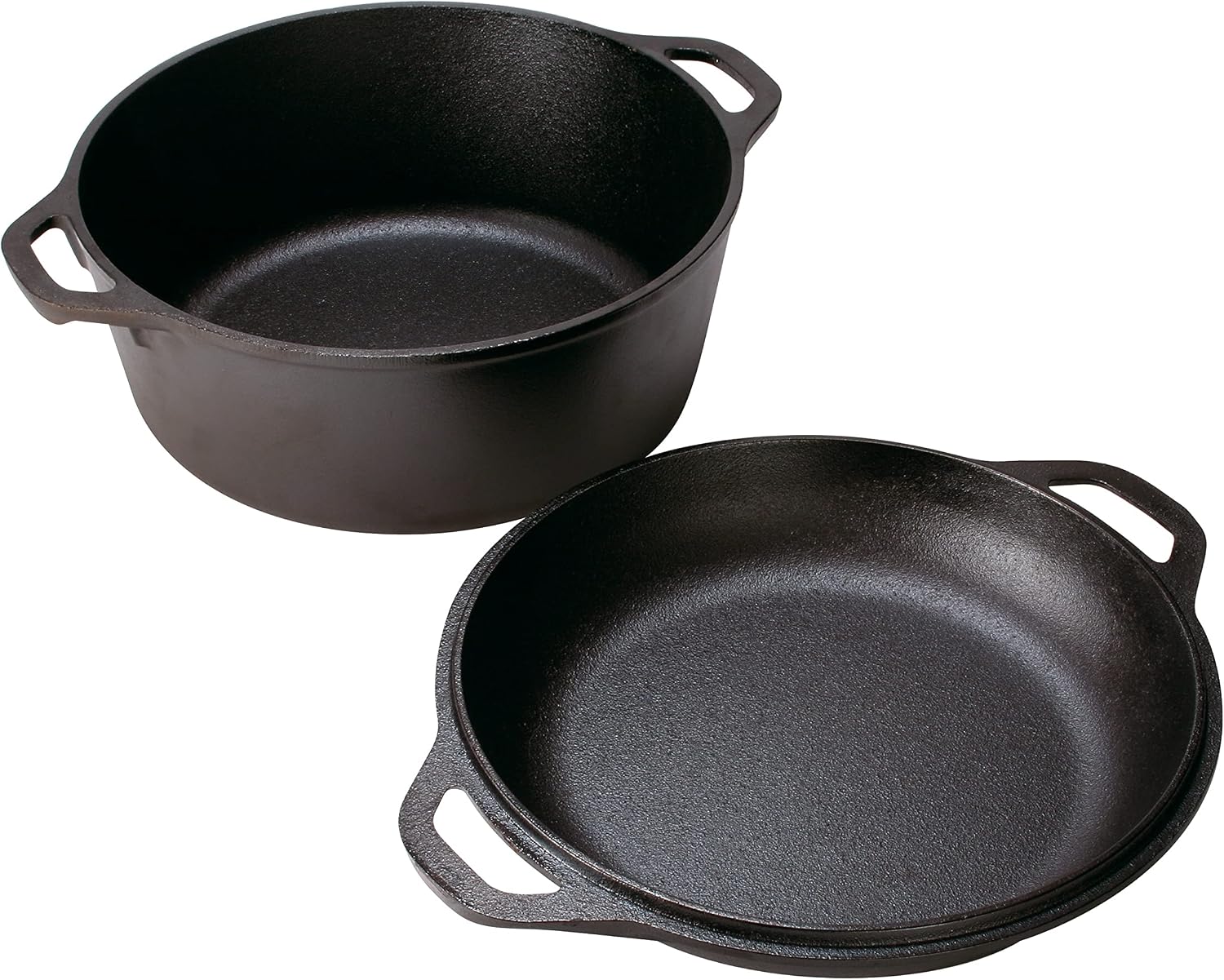
If you’ve ever stood over a pot pushing beef around in batches, watching the fond burn while you wait for the pan to re-heat, you already understand why the searing phase is the most frustrating part of building a serious chili. The Lodge Double Dutch Oven — a bare cast iron system that comes as a 5-quart pot with a lid that doubles as a 10.25-inch skillet (a skillet lid is exactly what it sounds like: a lid with a flat cooking surface, a short sidewall, and its own handle, so it functions as an independent pan) — was designed with this exact friction in mind. But most buyers discover the real workflow only after they’ve had the setup for a few months. This article maps out what experienced owners are actually doing with both pieces, why the simultaneous-cooking habit is the one that sticks, and where bare cast iron genuinely earns its keep versus where you might want your enameled pot instead.
Whether you’re building your first serious chili setup or you’re already cooking on a Lodge and wondering why you’re not using the lid more aggressively, you’ll leave here with a clear decision frame.
| EDITOR'S PICKLodge Chef Collection 6qt Doubl… | Mid-tierLodge Cast Iron Double Dutch Ov… | Budget pickEDGING CASTING 2-in-1 Pre-Seaso… | |
|---|---|---|---|
| Capacity | 6 qt | 5 qt | — |
| Pre-seasoned | — | ✓ | ✓ |
| Dual handles | — | — | ✓ |
| Oven-safe | — | ✓ | — |
| Price | $89.90 | $59.90 | $33.99 |
| See on Amazon → | See on Amazon → | See on Amazon → |
The Simultaneous-Sear Workflow: Why It Matters More Than It Sounds
The obvious use for the skillet lid is as a lid. Put it on the pot, trap moisture, done. Every owner figures that out in the first five minutes. What takes longer to discover is that the lid is also a fully functional 10.25-inch skillet that can run on a second burner at the same time the pot is heating.
The practical payoff for chili: you season and heat the pot on one burner for your aromatics, and you pre-heat the skillet lid on a second burner for searing beef, pork shoulder, or lamb. Both surfaces reach temperature simultaneously. You sear a batch in the skillet, transfer it to the pot, reload the skillet immediately — no waiting for the Dutch oven to recover heat, no crowding, no steaming instead of browning.
Reviewers of the Lodge Double Dutch Oven consistently describe this as the moment the system clicks. Across aggregated reviews on major retail platforms and cooking forums, the pattern is nearly identical: buyers who initially purchased for the braising pot report that after six to eight weeks of regular use, the skillet lid has become their default weekday sauté pan. Several EDGING CASTING Double Dutch Oven owners — EDGING CASTING produces a competing two-piece bare cast iron system in the same form factor — describe abandoning their standalone skillets entirely once the lid’s seasoning built up enough to handle eggs.
The time math is straightforward:
By the numbers
- Standard single-pot sear time for 3 lbs. of beef chuck (in batches): ~22–28 minutes
- Simultaneous two-surface sear (pot + skillet lid, staggered batches): ~12–16 minutes
- Estimated time saved per chili session: 8–14 minutes of active stove-time
Serious Eats’ Dutch oven buying guide notes that the single biggest workflow bottleneck in braises and stews is the searing phase, specifically the time lost to heat recovery between batches. The two-surface method directly addresses this without requiring a second full-size skillet.
Seasoning Both Pieces So They Develop Evenly — and the Protocol That Actually Works
Here’s where a lot of buyers lose the thread. They season the pot carefully and treat the skillet lid as an afterthought — or vice versa. After a few months, one surface is non-stick and the other is sticky and frustrating, and they blame the cookware.
The goal is to season both pieces on the same schedule so they age together. Food52’s guide on cast iron seasoning emphasizes that seasoning is cumulative: each cook deposits a thin layer of polymerized oil, and the surface improves not from any single seasoning session but from consistent, appropriate use over time.
One EDGING CASTING owner’s protocol, cited across multiple review threads, is worth treating as a real-world baseline rather than a generic recommendation: coat both pieces (pot interior, pot exterior, skillet lid cooking surface, skillet lid exterior) lightly with olive oil — thin enough that you’ve wiped off most of it with a clean cloth — then bake both in a 200°F oven for two or more hours before the first cook. The low temperature and extended time help the initial layer cure without the smoking and pooling that happens at higher temps if the oil coat is slightly too thick.
After the initial cure, the sequence that builds seasoning fastest is: fat-forward cooks first (bacon, ground beef, sausage), followed by drier cooks as the surface matures. Cook’s Illustrated’s Dutch oven guide notes that cast iron seasoning responds to use more than to oven sessions — a pot you cook in three times a week will outperform one you’ve baked six times but barely cooked in.
Realistic seasoning timeline: Most owners report that both pieces feel genuinely non-stick — meaning eggs slide, onions don’t grab, fond releases cleanly — after four to six weeks of regular cooking. That’s faster than the internet mythology around cast iron suggests. The learning curve that intimidates first-time buyers is consistently shorter in practice than expected, according to Apartment Therapy’s reader survey on Lodge cast iron ownership.
Wirecutter’s cast iron skillet review notes that bare cast iron’s reputation for difficulty is largely a relic of advice written for people who store their pans wet — standard kitchen use, with prompt drying and a thin wipe of oil after washing, is sufficient maintenance for most cooks.
Bare Cast Iron vs. Enameled for Long-Simmered Acidic Chili: The Real Tradeoff
This is the comparison that practitioners need to make explicitly, because the answer depends on what you’re cooking and for how long.
Bare cast iron and enameled cast iron (like Le Creuset or Staub) are both excellent for chili, but they perform differently under specific conditions:
Where bare cast iron wins:
- Searing. The Lodge Double Dutch Oven’s bare surface can handle higher dry-heat temperatures without risk of enamel chipping or thermal shock. Owners consistently report more aggressive browning — darker fond, better Maillard crust — from bare cast iron at high heat.
- Price per performance. The Lodge Double Dutch Oven delivers two functional cooking surfaces in the system; you’re not paying enameled-pot prices for the skillet lid, you’re getting it as part of the bundle.
- Bread baking. Bare cast iron is the standard for sourdough and no-knead breads because you can pre-heat it empty at 500°F without worrying about enamel. This use case appears in nearly every review cluster for bare cast iron Dutch ovens, and it’s a real secondary workflow for chili cooks who bake alongside.
Where enameled wins:
- Long-simmered acidic chili. Tomatoes, chile purees with high acidity, and long cooks (3+ hours) at a simmer will, over time, work against bare cast iron seasoning. Serious Eats’ Dutch oven guide notes that highly acidic ingredients can strip bare cast iron seasoning with repeated exposure — the surface recovers with re-seasoning, but enameled cast iron is simply non-reactive and requires no management. For a competition chili that simmers for four to five hours with a heavy tomato component, an enameled pot like Staub or Le Creuset is the lower-maintenance choice.
- Tomato-forward storage. You can leave chili in an enameled pot overnight in the refrigerator; doing the same in bare cast iron will dull the seasoning and can impart a faint metallic note over time.
The practical answer for most practitioners: Use the bare cast iron Double Dutch Oven for the sear and early-cook phase — aromatics, fat rendering, blooming dried chiles — then transfer to an enameled pot for the long acidic simmer if you’re cooking tomato-heavy chili for more than two hours. If your chili is chile-forward (dried chile purees, minimal tomato), bare cast iron handles the full cook without issue.
The Bread-Baking Overlap: A Secondary Workflow Worth Noting
The Double Dutch Oven’s dimensional profile — wide enough to handle a standard sourdough boule, with a lid that creates the trapped steam environment that makes bakery-style crust possible — has made it a crossover tool for home bakers. This shows up in nearly every review cluster for the product: buyers who bought it for chili and braises end up using it weekly for bread.
This matters for chili cooks because it changes the value calculation. If the pot and lid are pulling double duty between Saturday chili and Sunday bread, the cost-per-use math shifts significantly in favor of the bare cast iron system versus a single-purpose enameled braiser.
The pre-heat-empty step that bread baking requires (pot goes into a 500°F oven before you load the dough) also doubles as an aggressive seasoning session — the kind that polymerizes oil residue and builds surface texture faster than gentle use alone.
Frequently Asked Questions
Can the skillet lid from the Lodge Double Dutch Oven be used as a standalone frying pan on the stovetop? Yes — this is one of its most underrated features. The skillet lid is a fully functional 10.25-inch cast iron skillet with a flat cooking surface and its own handle. It sits stably on any burner, handles stovetop searing, sautéing, and frying independently, and behaves exactly like a standard cast iron skillet. Most owners who run it this way eventually start thinking of the system as a pot-and-skillet set rather than a Dutch oven with a lid.
How do you season a two-piece bare cast iron set so both pieces develop evenly? Season them together and cook with both on the same schedule. For the initial cure, one owner-tested protocol involves a thin olive oil coat on all surfaces, followed by a 200°F oven bake for two or more hours. After that, prioritize fat-forward early cooks (bacon, ground beef, sausage) in both pieces before moving to leaner proteins. Both pieces should be dried immediately after washing and wiped with a thin coat of oil — the goal is that neither piece ever sits wet or neglected while the other gets regular use.
What is the capacity difference between the standard Lodge Double Dutch and the Chef Collection version, and does it matter for a 6-quart chili? The standard Lodge Double Dutch Oven is a 5-quart pot; the Lodge Chef Collection version offers a slightly deeper 5-quart with a refined rim profile, but both are nominally the same volume. For a 6-quart chili recipe, either version will require you to scale down or transfer to a larger pot for the full simmer — neither version comfortably holds 6 quarts with headroom. If a 6-quart batch is your standard cook, consider the Lodge Double Dutch Oven as your searing vessel and finish in a larger enameled Dutch oven.
How does a bare cast iron double Dutch oven perform compared to an enameled pot for long-simmered acidic chili? Bare cast iron is excellent for the sear and the early cook, but repeated long exposure to acidic ingredients (tomatoes, vinegar-based hot sauce, citrus) will gradually strip the seasoning and may impart a faint metallic note. Enameled cast iron is non-reactive and requires no management for acidic cooks. For tomato-heavy chili simmered for more than two to three hours, the pragmatic move is to sear in the bare cast iron Double Dutch Oven and finish in an enameled pot. For chile-forward chili with minimal tomato, bare cast iron handles the full cook without issue.
How long does it realistically take to build a good seasoning layer on a new double Dutch oven? Most owners report that both pieces feel genuinely non-stick after four to six weeks of regular cooking — faster than conventional cast iron mythology suggests. The key variable is frequency of use and the type of food you cook: high-fat cooks (bacon, sausage, ground beef) build seasoning faster than lean or acidic cooks. An initial low-temperature oven cure helps, but the surface develops mainly through use, not through repeated solo baking sessions.
The decision rule: If your chili workflow involves a serious searing phase — multiple pounds of meat, staggered batches, significant time standing over a hot pan — the simultaneous two-surface workflow of the Lodge Double Dutch Oven is the clearest practical argument for the system. If your primary chili is tomato-heavy and simmers for four or more hours, pair it with an enameled pot for the long cook and let the bare cast iron handle what it does best: high heat, aggressive browning, and the kind of fond that makes a bowl taste like it took all day.