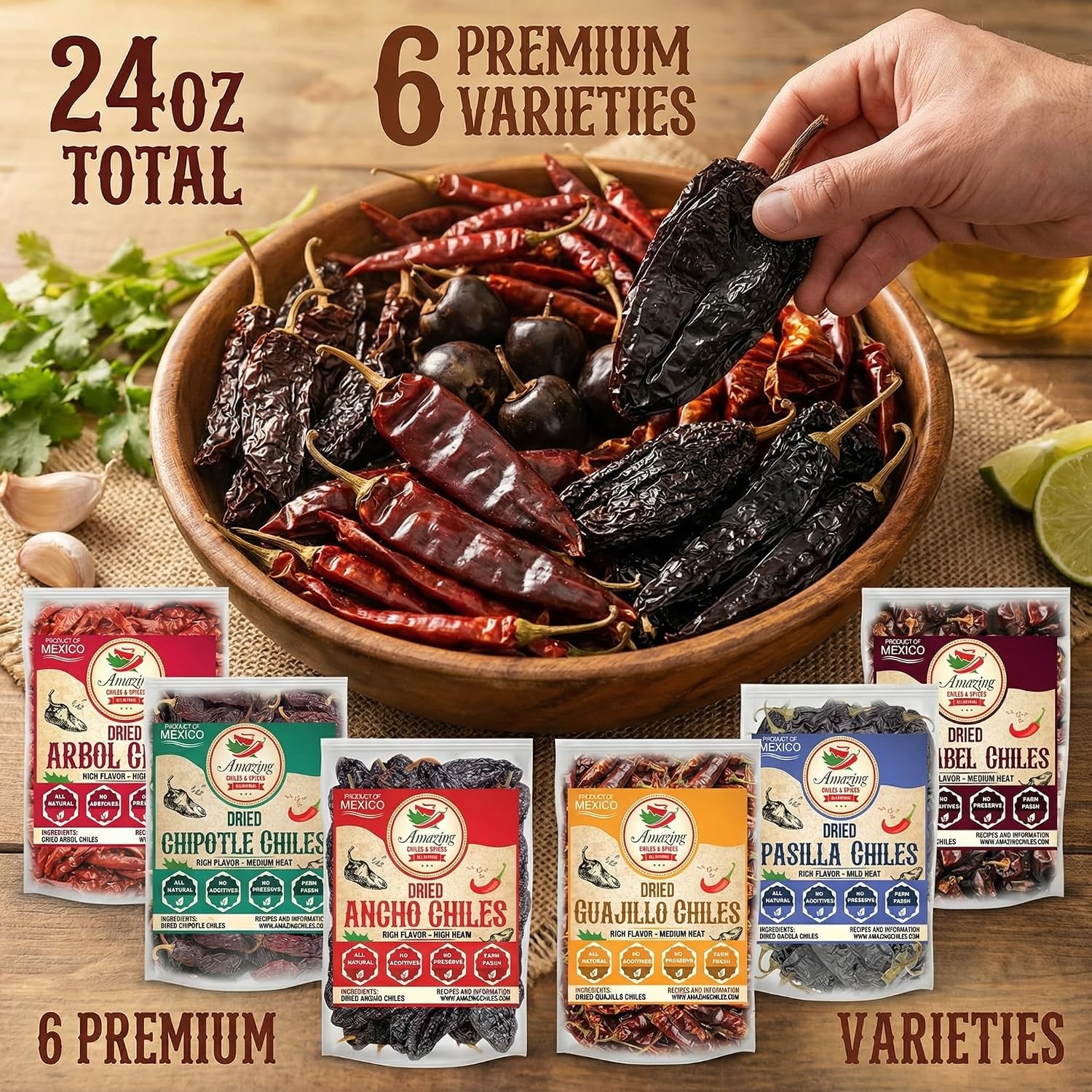
Six-Pack Dried Chile Variety Bundles Ranked: Which Sets Actually Cover a Serious Chili Pantry
If you’re new to cooking chili from scratch, “dried chiles” means exactly what it sounds like — whole peppers that have been dried and preserved, delivering a layered, complex flavor that pre-mixed chili powder simply cannot replicate. Each variety (ancho, guajillo, pasilla, cascabel, chipotle, mulato) has its own flavor profile, heat level, and role in a finished bowl. A variety bundle is a curated set of several different dried chile types sold together, often in resealable bags, letting you build a complete chili pantry in one purchase rather than tracking down each variety individually. If you live more than an hour from a serious Latin grocery, a well-chosen variety pack may be the most practical — and economical — way to stock up.
This guide ranks the most commonly available six-pack dried chile bundles by how well they actually serve a practicing chili cook: someone who already knows the difference between a fruity ancho and a tannic mulato, but is still building the instinct for which combination produces the bowl they’re chasing. The tradeoffs between bundles are real, the freshness variability is documented, and by the end you’ll have a clear decision rule.
| EDITOR'S PICKChile Powder Variety Pack (48 o… | Mid-tierDried Chile Peppers Variety Pac… | Budget pickDried Chili Peppers Variety Pac… | |
|---|---|---|---|
| Total weight | 48 oz | 12 oz | — |
| Pepper types | Ancho, Guajillo, Arbol | Ancho, Guajillo, Pasilla | Ancho, Arbol, Guajillo |
| Form | Ground powder | Whole dried | Whole dried |
| Pack count | — | — | 4 oz each |
| Pasilla included | ✗ | ✓ | ✗ |
| Arbol included | ✓ | ✗ | ✓ |
| Price | $34.97 | $18.95 | $18.95 |
| See on Amazon → | See on Amazon → | See on Amazon → |
Why a Six-Pack Bundle Beats a Three-Pack (For Serious Chili Work)
The standard three-pack — typically ancho, guajillo, and pasilla — covers the basic Texas red template and nothing more. That’s a competent starting point, and reviewers across those simpler sets consistently praise pliability and fresh aroma when shipments arrive in good condition. But one documented buyer complaint across multiple three-pack listings cuts to the heart of the limitation: “the peppers were so dry they crumbled on rehydration.” When you’re working with only three varieties and one arrives below quality threshold, you’ve lost 33% of your blend before the pot goes on.
A six-pack changes that math. You have redundancy — if the mulato is disappointing, the ancho and pasilla can compensate. More importantly, you gain access to chiles that genuinely expand the flavor vocabulary of your bowl. Per the Serious Eats guide to dried chiles, the difference between a three-chile and a six-chile blend isn’t just additive; it’s dimensional. Fruity heat (cascabel), smoky depth (chipotle), and dark chocolate bitterness (mulato) don’t just layer — they interact to create a finished chili that reads as more than the sum of its parts.
The freshness risk exists with any dried chile purchase, but reviewers who specifically cite six-packs report something useful: the resealable bag format that most current six-pack bundles use has largely solved the staleness-on-arrival problem that plagued older cellophane-packaged competitors. This is a genuine differentiator worth weighting in your buying decision.
By the numbers:
| Bundle Size | Chile Varieties | Redundancy if One Fails | Flavor Dimensions Covered |
|---|---|---|---|
| 3-pack | 3 | Low | Fruity / Earthy / Mild Smoke |
| 6-pack | 6 | High | Fruity + Earthy + Smoke + Heat + Bitter + Floral |
How the Best Six-Pack Bundles Are Structured (And What to Look For)
The most useful six-packs for chili work follow a deliberate logic: at least two “base” chiles that provide body and mild sweetness (ancho, pasilla), one heat carrier (guajillo or de árbol), one smoky element (chipotle), one complexity wildcard (cascabel or mulato), and one that bridges categories (ancho mulato or negro). When a bundle deviates from this architecture — say, by including two smoke chiles and no bright fruity heat — the resulting blends tend to read as one-dimensional regardless of individual chile quality.
According to Saveur’s chile pantry coverage, the ancho-guajillo-pasilla backbone is so well-established in competition chili that judges unconsciously expect it as a foundation. What separates a winning bowl is what gets layered on top of that foundation. This is the practical argument for choosing a six-pack with genuine variety rather than a “more of a good thing” bundle that gives you three anchos and three guajillos under different labels.
What reviewers consistently flag as differentiators in high-rated bundles:
- Resealable bags: Near-universal praise point. Once you open a 2-oz bag of cascabel and use half, your storage solution is built in. Older bundles in heat-sealed cellophane require you to have your own airtight container plan immediately.
- Visible harvest dating or packing dates: The best suppliers print these on individual bags. This matters more than most buyers realize — old-crop chiles (harvested 18+ months before purchase) have measurably reduced essential oil content, which translates directly to blander finished chili.
- Whole, unbroken pods: Broken chiles aren’t ruined, but excessive breakage suggests handling damage and correlates with dryness complaints.
The Chipotle Position: Why This One Chile Makes or Breaks a Six-Pack
If there’s a single chile that distinguishes a thoughtfully curated six-pack from a commodity bundle, it’s the chipotle. One reviewer’s description — calling it “like dried figs and apricots behind the deep smoky pepper flavor” and rating it ten out of ten — points to exactly what a quality dried chipotle delivers that chipotle powder or canned chipotles in adobo cannot: the preserved fruit complexity of a jalapeño that was fully ripened to red before drying over mesquite smoke. That layered stone-fruit-and-smoke quality is what makes it worth including in a chili blend alongside ancho and pasilla rather than just adding smokiness alone.
The practical implication for bundle evaluation: if a six-pack’s chipotle smells flat or purely smoky with no sweetness when you open the bag, the chile is either old or was harvested underripe. Per Chili Pepper Madness’s rehydration guide, quality dried chipotles should release a complex, slightly sweet aroma even before any liquid contact. Flat smell on opening is your early warning indicator.
This is also the chile where the “rural pantry” argument is strongest. Buyers who cite variety packs as their only access to a complete chili chile pantry specifically mention chipotle as the hardest individual variety to source locally in whole dried form (as opposed to ground powder or canned). A six-pack that includes a quality dried chipotle is doing real work for that buyer segment.
Whole Chiles vs. Ground Powder Bundles: The Tradeoff Is Real
Ground chile powder variety packs serve a genuinely different audience and use case — cooks who want to blend their own seasoning without the rehydration step. Food52’s dried chile pantry coverage notes that whole dried chiles and ground chile powders are not interchangeable in technique, even when made from the same base pepper. Whole chiles, when rehydrated and blended, produce a paste with a silkier texture and fresher-tasting heat. Ground powders bloom faster in hot fat and integrate more evenly into quick-cooked or competition-format chilis where time is a variable.
For the intermediate practitioner making their first serious from-scratch chili, this is a genuine decision point:
- Choose whole-chile bundles if you have a blender, are willing to do a 20-minute rehydration step, and want the deepest possible flavor extraction. This is the correct path for a Texas red or New Mexico-style bowl.
- Choose ground powder bundles if you’re building a custom seasoning blend, cooking for large groups where speed matters, or want to dial in ratios precisely before committing to whole-chile sourcing.
The answer for most serious cooks is eventually both — but if you’re buying your first or second bundle, the whole-chile version teaches you more about what each variety actually tastes like in isolation.
The Cascabel Question: What This Chile Adds That Nothing Else Does
Cascabel (Spanish for “rattle” — named for the sound the seeds make inside the dried pod) is the most underrepresented variety in beginner chili pantries, and the one that most reliably elevates a six-pack above competition-circuit predictability. Per Serious Eats’ dried chile guide, cascabel delivers a nutty, slightly woodsy heat with a round, medium-spice finish that doesn’t announce itself the way guajillo does. It integrates rather than leads.
In practical blend terms: cascabel is the chile that makes experienced tasters say a bowl has “depth” without being able to identify why. It fills the mid-register of the flavor profile that ancho (fruity, mild) and chipotle (smoky, sweet) tend to skip over. A six-pack without cascabel is covering five dimensions well; a six-pack with a quality cascabel is covering six.
Frequently Asked Questions
Is it better to buy a variety pack or individual bags of each chile if you cook chili regularly?
Once you have a clear preference for your go-to blend — say, two anchos for every one guajillo and a half-chipotle for a batch — buying individual bags in larger quantities is more economical and gives you better quality control per variety. Variety packs are optimal at the learning and experimentation stage, when you’re still mapping your own flavor preferences, and remain useful for accessing hard-to-source varieties (cascabel, mulato, negro) that may not be stocked individually at your nearest retailer.
How do you store a six-pack of dried whole chiles once the bags are opened?
The resealable bag the bundle comes in is adequate for short-term storage (2–4 weeks) if you press out excess air before sealing. For longer storage, transfer opened bags to glass mason jars with tight-fitting lids, keep them in a cool, dark cabinet away from the stove, and use within 6 months for best flavor. Avoid the refrigerator — humidity fluctuations cause condensation that accelerates mold risk on dried chiles.
Can you mix whole dried chiles from a variety pack with ground powder versions in the same chili?
Yes, and experienced competition cooks do this deliberately. A common technique is to use rehydrated whole chiles for the primary paste (body, texture, deep flavor) and finish with a small amount of ground powder in the fat-bloom stage for brightness and integration. The key is adding ground powders to hot fat before any liquid goes in — this unlocks the fat-soluble compounds that carry their flavor.
What does cascabel add to a chili that the other five chiles in a six-pack cannot?
Nutty, mid-register warmth with a woodsy finish. Ancho brings fruit; guajillo brings bright, tannic heat; pasilla brings earthiness; chipotle brings smoke and sweetness; mulato brings dark chocolate bitterness. Cascabel fills the nutty-savory middle ground that none of the others cover. Bowls built without it tend to taste either bright or dark but rarely both simultaneously.
How do you know if a dried chile from a variety pack is too old to rehydrate properly?
Three indicators: First, snap a small piece — a fresh dried chile bends before breaking; an old one snaps immediately and may crumble. Second, smell the interior after breaking — fresh dried chiles release a complex, slightly fruity or smoky aroma; old ones smell flat or dusty. Third, after a 20-minute hot-water soak, old chiles remain leathery and won’t blend smoothly, while fresh ones become fully pliable. If two of three indicators fail, the chile will produce noticeably less flavor in a finished bowl and you should factor that into your blend quantities accordingly.
The Decision Rule
If you’re building a chili pantry from scratch — especially in a rural market with limited Latin grocery access — buy a six-pack whole-chile bundle with resealable bags, visible packing dates, and a chipotle inclusion. The variety redundancy and access breadth justify the format over individual bags at this stage.
If you already have ancho, guajillo, and pasilla stocked and want to expand, prioritize a bundle that leads with cascabel, mulato, and chipotle — the three varieties most responsible for the gap between a competent and a memorable bowl.
If your workflow prioritizes speed over depth, the ground powder variety pack is a legitimate choice, not a compromise — use it intentionally, not by default.
The six-pack format rewards the cook who treats it as a curriculum. Each variety teaches you something different about what heat, smoke, fruit, and bitterness actually mean in a chili context. The bundles that earn shelf space are the ones built around that logic.