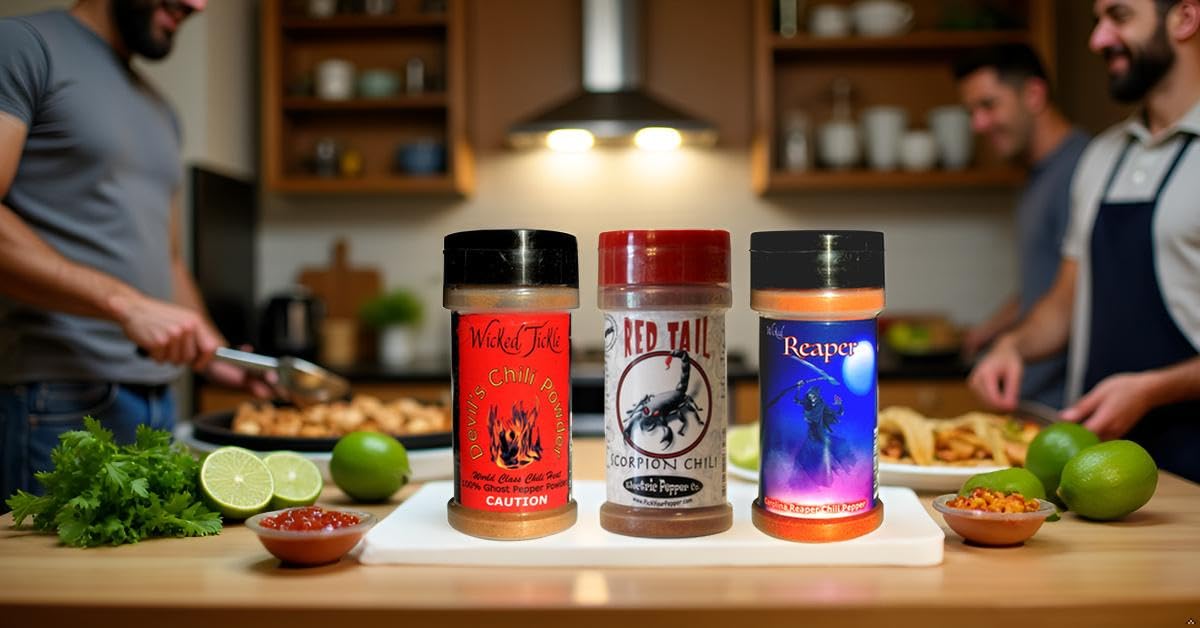
If you’ve ever added a pinch of regular chili powder to a pot and thought, I wish this had more kick, you’ve probably started browsing ghost peppers, scorpion peppers, and Carolina Reapers. These are the three most prominent “superhot” chile varieties — a category defined by heat ratings above 1 million Scoville Heat Units (SHU), which is the standard scale measuring capsaicin concentration, the compound responsible for the burning sensation in hot peppers. For context, a jalapeño sits around 5,000 SHU; a habanero tops out near 350,000. Ghost peppers start at roughly 1 million. Scorpion peppers push past 1.2 million. Carolina Reapers — the current record holder as of the most recent Guinness World Records certification — average around 1.6 million and have been measured above 2.2 million in individual specimens. This guide will help you buy the right powder for actual cooking, understand what each variety brings beyond raw heat, and use it without turning your six-quart pot into a weapon.
The critical thing most buying guides skip: these powders are not interchangeable heat sources. Each produces a different onset timing, a different location of burn in your mouth and throat, and a different flavor character that matters in a real bowl of chili. Buying the hottest one because it’s the hottest is the wrong frame. Buying the right one for your recipe — and knowing how to dose it — is the actual skill.
Flavor First: What Superhot Powders Actually Taste Like
The most useful thing reviewers of the Wicked Reaper Extreme Heat Set (which includes ghost, scorpion, and Reaper powders together) keep returning to is this: the heat is real, but so is the flavor. Ghost pepper brings a fruity, slightly smoky sweetness that Chili Pepper Madness’s ghost pepper guide describes as reminiscent of dried fruit — almost raisin-like when used in small quantities. Scorpion peppers lean floral and tropical, with a bright citrus edge that Saveur’s ranking of the world’s hottest peppers notes sits closer to a habanero in character than to a Reaper. Carolina Reaper is the outlier: cinnamon-forward and genuinely sweet before the heat arrives, with a delayed but prolonged burn that reviewers of the Wicked Reaper set consistently describe as “waves” rather than a single spike.
Owners of the Wicked Reaper set specifically flag that using these three powders side by side in the same dish reveals distinct personalities — this isn’t heat-scale trivia, it’s flavor decision-making. The set’s format also gives you a built-in A/B comparison without committing to large quantities of any single powder, which is the smart entry point.
Serious Eats’ Food Lab guide to ground chiles makes the broader point that flavor in dried chile powders is volatile and degrades faster than heat. This means a ghost pepper powder that smells flat when you open the jar has already lost the fruity aromatics that distinguish it from generic cayenne heat. Buy from sources with visible turnover or clearly printed production dates.
The Three Powders: Heat Profiles Side by Side
Understanding the experience of heat — not just the number — is what separates a well-calibrated bowl from a one-note punishment exercise.
By the Numbers
| Powder | Avg. SHU Range | Onset Speed | Peak Location | Duration |
|---|---|---|---|---|
| Ghost Pepper | 1.0M–1.2M | Medium (15–30 sec) | Front of mouth, throat | Medium |
| Scorpion | 1.2M–1.4M | Fast (under 15 sec) | Lips, tongue | Medium-long |
| Carolina Reaper | 1.4M–2.2M | Slow (30–60 sec) | Deep throat, chest | Long (30+ min) |
SHU ranges per Chili Pepper Madness pepper heat scale documentation; onset/duration characterizations drawn from aggregated owner reviews.
The practical implication for chili: ghost pepper is the most forgiving to cook with because its medium onset gives you a clearer read on where the heat is landing as you eat. Scorpion’s fast front-of-mouth hit is easy to sense in small tastes, which helps with incremental dosing. Reaper is the most dangerous to use casually because its slow onset means you’ll taste and think not that hot yet — then add more — then regret it thirty seconds later when the full effect arrives.
Cook’s Illustrated’s dried chile powder tasting notes emphasize that heat perception in a fat-based cooking medium (like the rendered fat in a chili base) is meaningfully different from heat in water. Fat carries capsaicin efficiently, which is why the “boiling water ratio” reviewers cite as a starting point — roughly ½ teaspoon per 2 cups of water — actually translates to a lower effective dose in a full chili, where fat distribution amplifies the sensation. In a standard 6-quart chili recipe with a pound or more of fatty ground meat or beef chuck, treat that ½ tsp per 2 cups water benchmark as a ceiling, not a floor.
Which Product to Buy and Why
If you want to explore all three: Wicked Reaper Extreme Heat Set
The Wicked Reaper set’s case for existing is exactly what reviewers make of it: you get ghost, scorpion, and Reaper in a single purchase, the granule quality is consistent across all three jars, and the format enforces side-by-side comparison. Owners report that each 2 oz bottle at this heat level lasts several months of regular cooking — small quantities go a long way, so buying three large bottles of powders you’ve never cooked with is genuinely wasteful. The set format solves that problem structurally.
One thing reviewers don’t overstate but is worth underlining: the set functions as a curriculum. You will learn something about each pepper’s behavior in your cooking that you can’t learn from reading a description. That’s worth more to a developing cook than any single optimized powder at a higher quantity.
If granule size matters to you: Wicked Tickle Extreme Heat Powder
Owners of Wicked Tickle specifically call out the granule size as a practical differentiator. Several reviewers contrast it explicitly with finer-ground competitors that become airborne during measuring — a real issue with superhot powders, where even ambient powder in the air around a measuring spoon can cause eye irritation and respiratory discomfort. Coarser granules stay in the spoon. If you’re cooking in a smaller kitchen, doing multiple batches, or cooking with other people nearby who aren’t expecting a face full of Reaper dust, this is a genuine safety consideration, not a marketing footnote.
The coarser grind also dissolves slightly more slowly in liquid, which means more even distribution through a long-simmered chili rather than a concentrated hot spot near where you added it. Stir thoroughly either way.
If this is a gift or an entry point for someone new to superhots: KITSY BOX Extreme Pepper Variety Set
The KITSY BOX earns its reputation among reviewers primarily as a well-packaged exploratory gift — the presentation is consistently praised, and the variety range gives a recipient the same built-in comparison advantage as the Wicked Reaper set. One reviewer specifically notes it works well for someone who wants to understand the superhot category without committing to a large purchase of any single powder. For the culinary gift-giver audience, this is the cleaner recommendation: it reads as intentional, it’s visually coherent as a gift, and it sets the recipient up to actually learn something rather than just own something hot.
Dosing Safely in a Real Chili
The reviewer-cited benchmark — ½ teaspoon per 2 cups boiling water — is a useful calibration point, but chili isn’t boiling water. Here’s how to adapt it:
For a 6-quart pot of chili (standard home batch): Start with ⅛ to ¼ teaspoon of any superhot powder for a noticeable but manageable heat addition. Add it early, let it cook for at least 20–30 minutes, and taste before adding more. The long simmer distributes and slightly mellows the heat; tasting immediately after adding will underestimate the final result.
Incremental rule: Add, stir thoroughly, wait 20 minutes, taste. Never add a second dose before the first has fully integrated. This is the single most common mistake owners describe in their reviews — doubling down before the first addition has had time to register.
Blending with your base chili powder: Superhot powders work best when they’re amplifying a complex ancho-guajillo base, not replacing it. Think of them as a heat amplifier with flavor side effects, not a standalone seasoning.
Safe Handling in a Home Kitchen
Chili Pepper Madness’s handling guides and aggregated owner reviews across all three products converge on the same practical points:
- Gloves are not optional with Reaper-level powders. Nitrile kitchen gloves before opening the jar. Capsaicin binds to skin and doesn’t wash off easily with water alone — you need soap, ideally dish soap with a degreasing agent, repeated twice.
- Measure over the sink or away from your face. Coarser granules (see: Wicked Tickle) help, but any fine powder that becomes airborne near your eyes causes significant discomfort.
- Milk, not water, is your first aid. Capsaicin is fat-soluble, not water-soluble. Water spreads it. Dairy (milk, yogurt, sour cream) contains casein, a protein that binds to capsaicin and removes it. Keep full-fat dairy accessible when working with superhot powders.
Frequently Asked Questions
How much ghost pepper or Carolina Reaper powder should you add to a 6-quart pot of chili? Start with ⅛ teaspoon for any superhot powder in a 6-quart batch. The ½ tsp per 2 cups water benchmark cited by Wicked Reaper reviewers is a reference point for heat sensation in water — fat carries capsaicin more efficiently, so your effective chili dose is lower. Add incrementally and wait 20 minutes between additions.
Do extreme chile powders have any flavor beyond heat, or are they just for Scoville bragging rights? They have real flavor. Ghost pepper is fruity and faintly smoky. Scorpion is bright and floral with citrus notes. Carolina Reaper has a genuine sweetness and cinnamon character. All three are distinguishable from each other and from generic cayenne in a finished bowl — owners of the Wicked Reaper set consistently report this as the most surprising discovery when using them side by side.
How do you handle extreme chile powder safely in a home kitchen? Wear nitrile gloves. Measure over the sink. Choose coarser-ground products like Wicked Tickle to minimize airborne powder. Wash hands with dish soap twice. Keep full-fat dairy nearby. Don’t touch your face or eyes during handling.
Can you fix a chili that’s too hot after you’ve already added extreme powder? Partially. Adding more fat (a spoonful of lard, a drizzle of oil) helps distribute and slightly mute the heat. Adding more bulk (beans, additional tomato, a second can of crushed tomatoes) dilutes concentration. Dairy stirred in at the end — sour cream, a swirl of heavy cream — binds capsaicin and reduces perceived heat at the moment of eating. None of these fully reverse an overdose, but combining all three can bring an over-hot pot back to edible. Saveur’s pepper explainer notes that acid (vinegar, citrus) does not reduce capsaicin heat and can actually sharpen perception — avoid that instinct.
What is the difference in heat effect between ghost pepper, scorpion, and Carolina Reaper in the same dish? Ghost produces a medium-onset, front-to-throat burn of moderate duration. Scorpion hits fast at the front of the mouth and lips. Reaper has a slow, delayed onset — 30–60 seconds — but produces the longest, deepest burn centered in the chest and throat. In a chili context, this means Reaper is the hardest to dose incrementally because you’ll under-sense it on an immediate taste, add more, and then experience the full effect minutes later. Ghost is the most forgiving for calibration. Scorpion sits in between.
The decision rule: If you’re building toward precision — understanding what each superhot brings so you can make intentional choices — start with the Wicked Reaper set. If you cook regularly and want a daily-driver superhot with better kitchen ergonomics, Wicked Tickle’s granule size earns its reputation. If you’re buying for someone else who’s curious but not yet committed, the KITSY BOX is the gift that actually teaches something.
Heat without flavor is a stunt. These powders, used well, are not that.