If you’ve ever made a pot of chili that turned out either aggressively hot or frustratingly flat, the culprit is almost always your powder — and specifically, the mismatch between what’s printed on the label and what actually ends up in the bowl. The Scoville scale is the standard measurement for chile heat: it expresses how much sugar water is needed to dilute a chile extract until trained tasters can no longer detect the burn. A mild bell pepper scores zero; a jalapeño lands somewhere between 2,500 and 8,000; pure capsaicin (the compound that makes chiles hot) tops out near 16 million. Chili powders — the blended or single-chile powders you’re adding by the tablespoon — fall on a wide range of that scale, and the volume of a 6-quart Dutch oven amplifies every miscalculation. This guide maps the Scoville landscape specifically for pot-scale cooking: what to buy at each heat tier, where the real-world numbers land after dilution and cook time, and how to make a decisive call when you’re standing in a spice aisle or browsing a specialty retailer.
Why the Scoville Number on the Label Isn’t the Number in Your Bowl
Here’s the frustration most intermediate cooks hit: a powder rated at 10,000 Scoville Heat Units (SHU) doesn’t deliver a bowl at 10,000 SHU. It never does. There are three variables doing the work of translation.
Dilution math. A standard scratch chili in a 6-quart pot might contain three to four pounds of meat, 28 ounces of crushed tomatoes, a pound of beans, aromatics, and liquid — somewhere in the range of 10–12 cups of total volume. If you add three tablespoons of a 5,000 SHU powder (a reasonable starting point for a medium-hot Texas-style chili), the capsaicin is being distributed across roughly 96–100 ounces of food. As Chili Pepper Madness’s Scoville Scale guide explains, perceived heat in a finished dish is a function of both SHU and capsaicin concentration — dilution drops perceived heat significantly relative to the powder’s raw rating.
Fat binding. Capsaicin is fat-soluble. In a chili with ground beef or pork, rendered fat during the long braise binds a meaningful fraction of the capsaicin, softening peak heat while extending its warmth through the palate. Leaner chilis — ground turkey, chicken, or beans-only — deliver more of the powder’s rated heat because there’s less fat to absorb it.
Cook time. Capsaicin itself is remarkably heat-stable, but prolonged high heat (two-plus hours above 200°F) can volatilize some aromatic compounds that accompany the heat, making the spice feel sharper and less layered. This is one reason competition cooks on the circuit often hold their hottest powders back, adding a final hit in the last 20–30 minutes of cook time rather than at the beginning.
The working rule: Assume your finished bowl will deliver roughly 15–25% of the powder’s labeled SHU rating in perceived heat, adjusted upward for lean proteins and downward for high-fat builds. A 10,000 SHU powder in a fatty beef chili reads closer to 1,500–2,500 SHU at the table.
The Heat Tiers: What to Buy and When
Mild Zone: 500–3,000 SHU
This is the flavor-first range. The powders here are about color, earthiness, and body — they add depth without heat as the lead character.
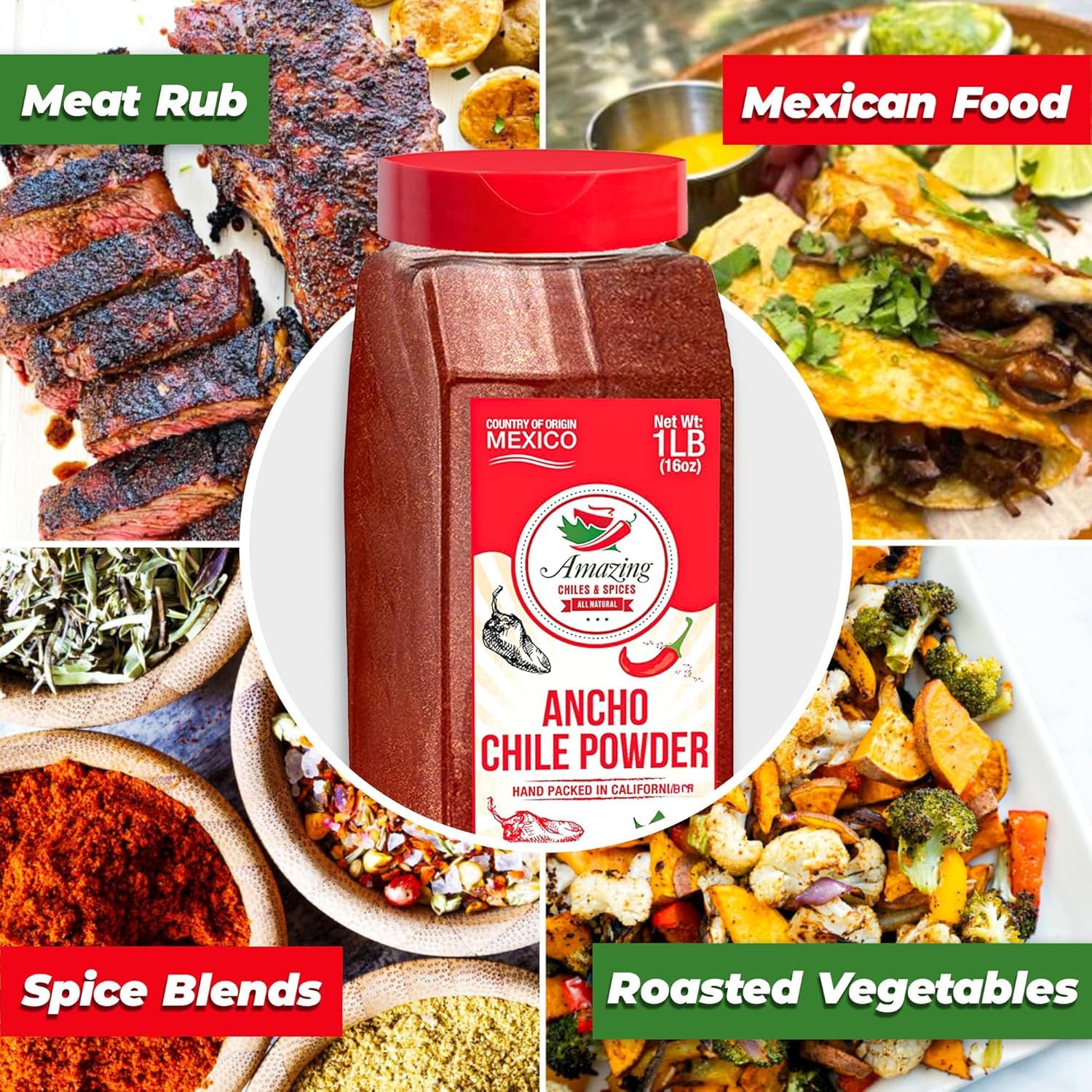
Ancho powder (dried poblano, typically 1,000–1,500 SHU) is the foundation of most serious red chili pastes. Its flavor profile is raisin, dried cherry, and mild cocoa. Saveur’s field guide to dried chiles describes ancho as “the workhorse of Mexican-American chili tradition” — it’s the base layer that makes everything else taste like it belongs.
Pasilla powder (1,000–2,500 SHU) is a slightly darker, more herbal companion to ancho. Rancho Gordo sources both of these in single-origin dried form, and the current-crop difference is real: fresh-harvest pasilla has a sharper, more tea-like back note that older stock loses entirely.
Guajillo powder (2,500–5,000 SHU, straddling mild and medium) brings cranberry and mild tartness. It’s the powder that makes a chili taste bright rather than muddy.
Practical call for a 6-quart pot: Build your base with 3–4 tablespoons of ancho plus 1–2 tablespoons of pasilla. This sets the color (deep mahogany-red) and the low aromatic floor. No perceivable heat will be present at this ratio for most palates — you’re building flavor scaffolding.
Medium Zone: 3,000–15,000 SHU
This is where most scratch chili cooks are operating, and where the biggest sourcing decisions live.
New Mexico / Hatch-style powders (2,000–5,000 SHU depending on variety and harvest) are the mild-medium crossover. Burlap & Barrel’s single-origin New Mexico red chile powder is consistently flagged by reviewers as having significantly more brightness than grocery-shelf blends — the difference attributed to more recent harvest and minimal industrial processing. For a 6-quart pot, 2 tablespoons adds gentle warmth that most adults register as “flavorful” rather than “hot.”
Guajillo at the medium range (3,000–5,000 SHU processed form): this is worth calling out separately because grocery-shelf guajillo powder often sits in that range due to blending and age. Diaspora Co. and Burlap & Barrel sources have tested higher in reviewers’ accounts — owners report noticeably more front-of-palate heat compared to commodity versions.
Cascabel powder (1,500–4,000 SHU) is underused in home kitchens but carries a nutty, slightly smoky quality that Cook’s Illustrated’s chili powder taste tests have praised for its contribution to body without sharpness.
Chipotle powder (2,500–8,000 SHU) is smoked jalapeño, and its heat lands differently than fresh-dried chile powders — the smoke adds a layer that reads as intensity before the burn hits. For a 6-quart pot, 1 tablespoon is usually the ceiling unless you want smoke to dominate.
Practical call for medium heat: A combination of 2 tablespoons New Mexico or guajillo + 1 tablespoon chipotle in a 6-quart beef chili will land in the “perceptible warmth, finishes with a back-of-throat glow” zone for most palates — approximately equivalent to a mid-range restaurant “medium spicy.”
By the Numbers: Powder-to-Bowl Heat Translation
| Powder | Raw SHU | Tablespoons in 6-qt pot | Estimated Bowl SHU |
|---|---|---|---|
| Ancho | 1,000–1,500 | 3 tbsp | ~150–250 |
| New Mexico | 2,000–5,000 | 2 tbsp | ~300–750 |
| Chipotle | 2,500–8,000 | 1 tbsp | ~200–600 |
| Chile de árbol | 15,000–30,000 | 1 tsp | ~400–1,100 |
Estimates assume a 10–12 cup finished volume, moderate fat content, 90-minute braise. Per Chili Pepper Madness’s dilution framework.
Hot Zone: 15,000–50,000 SHU
At this tier, you’re working in precision increments. A teaspoon, not a tablespoon, is your unit of measure.
Chile de árbol powder (15,000–30,000 SHU) is the most versatile hot-range powder in this context. Its flavor is clean and bright — almost grassy — with heat that builds quickly on the palate. Serious Eats notes that chile de árbol gives heat without muddying the underlying chile profile of a well-built base.
Cayenne (30,000–50,000 SHU) is the baseline comparison for everything here. It’s pure heat with minimal flavor contribution. Epicurious’s guide to building chili heat specifically calls out cayenne as a “corrective tool, not a base ingredient” — use it in ¼-teaspoon increments to dial up at the end of cook time when you need more heat without changing your flavor profile.
Piquín powder (40,000–60,000 SHU) is a regional Texas favorite that shows up in serious CASI and ICS competition circles. Its burn is fast, bright, and short — it doesn’t linger the way cayenne does. Penzeys carries a dried piquín that reviewers consistently rate as one of the more flavor-forward entries at this heat tier.
Practical call for a hot build: For a competition-leaning or heat-forward bowl, hold your base architecture (ancho + guajillo/New Mexico) and add chile de árbol by the ½-teaspoon at the last 30 minutes of cook time, tasting every 10 minutes. The pot’s residual heat will continue extracting capsaicin as it sits.
Extreme Zone: 50,000 SHU and Above
This territory — habanero powder (100,000–350,000 SHU), ghost pepper powder (900,000+ SHU) — is rarely appropriate for a 6-quart competition or dinner-table chili. Where it appears legitimately is in microblends: a pinch of habanero powder added to a medium-heat chili lifts the aromatic ceiling without necessarily making the chili “hot” in a linear sense, because habanero’s fruity, floral top note is distinct from its heat. Treat powders above 50,000 SHU as flavor additives measured in pinches, not functional heat sources.
Building a Layered Powder Shelf for a 6-Quart Practice
The intermediate-practitioner mistake is buying one “chili powder” blend and calling it done. Commercial blends combine several dried chiles, cumin, garlic, and sometimes salt, which removes your ability to control each variable independently. Once you’re cooking at this tier, separate powders are the right call.
A four-item shelf that covers most scenarios:
- Ancho (flavor base, low heat) — Rancho Gordo whole dried for grinding or Penzeys powder
- New Mexico or guajillo (medium brightness) — Burlap & Barrel or Diaspora Co. for current-crop sourcing
- Chipotle (smoke and warmth) — any reputable single-ingredient source; check for a pack date within 12 months
- Chile de árbol or cayenne (heat adjustment) — held back for final 20–30 minutes
With these four, you can build from mild to genuinely hot and adjust brightness, smoke, and earthiness independently. You’re no longer buying heat — you’re composing it.
The Decision Rule
If you’re cooking for a mixed crowd (kids, heat-averse guests, or anyone you haven’t calibrated), anchor your build in the mild-to-medium zone and serve a small dish of chile de árbol oil or dried flakes on the side. The bowl reads as rich and complex; the heat is opt-in.
If you’re cooking for a competition or a known heat-tolerant table: build your base with ancho and guajillo at full tablespoon ratios, add chipotle for smoke, and use chile de árbol in measured teaspoons starting at the 60-minute mark. Taste every 15 minutes. Pull the pot when you’re one tasting step below target — it’ll climb another notch as it cools to serving temperature and capsaicin continues distributing.
If you’re building a heat that lingers (competition judges often favor a controlled back-palate glow over a sharp front hit): lean toward piquín over cayenne for your adjustment layer. The finish reads as intentional rather than corrective.
The Scoville number is a starting coordinate, not a destination. The bowl is where the translation actually happens — and that translation is a skill you calibrate one pot at a time.