An enameled Dutch oven is, at its core, a heavy cast-iron pot coated inside and out with a glass-like enamel finish. That coating means no seasoning required, no reactivity with acidic ingredients like tomatoes or dried chiles, and easy cleanup. For chili specifically, it is the single most impactful piece of cookware you can own: the thick iron walls hold and distribute heat evenly, a tight-fitting lid traps steam and concentrates flavor, and the bright interior helps you monitor fond — the browned bits that tell you when your beef or pork is ready to deglaze. Three brands dominate most buying conversations right now: Lodge, the American stalwart; Le Creuset, the French benchmark that many home cooks treat as the definitive answer; and Misen, a newer direct-to-consumer brand challenging both on price and engineering claims. All three make a 5–6 quart enameled Dutch oven that can carry a pot of chili from raw ingredients to a finished simmer. But owner experience after 12-plus months of real cooking tells a more nuanced story than any spec sheet does.
The Price-to-Performance Framework You Actually Need
Before diving into what owners say, it helps to frame the numbers honestly.
- Lodge 6 qt. Enameled Dutch Oven: typically $60–$80 at retail
- Misen 5.5 qt. Dutch Oven: typically $165–$185 at retail
- Le Creuset 5.5 qt. Round Dutch Oven: typically $380–$420 at retail
That spread — roughly 5× from Lodge to Le Creuset — is the central tension of this comparison. The question is not whether Le Creuset is a better pot in some abstract sense. The question is whether it is better enough, for how you actually cook, to justify the gap.
Cook’s Illustrated, in their Dutch Oven Buying Guide (2024), notes that wall thickness affects heat retention and evenness but that enamel quality, lid seal, and handle ergonomics matter equally over a long cook. Wirecutter (New York Times), in their updated 2025 Dutch oven coverage titled “The Best Dutch Oven,” echoes this finding: across their evaluation framework, Lodge consistently outperforms its price point, while Le Creuset earns its premium through enamel finish quality and fit-and-finish consistency — not raw iron mass alone. Apartment Therapy’s 2024 feature “Lodge vs. Le Creuset: Is the Price Difference Worth It?” surfaces the same recurring claim from owners — that Lodge’s walls feel as thick or thicker than Le Creuset’s — and treats it as worth examining rather than dismissing.
How Each Pot Performs for Real Chili Cooks
The sections below break each brand into its own tier assessment, drawing on aggregated owner accounts documented by Wirecutter, Serious Eats, Cook’s Illustrated, Food52, and Apartment Therapy. No brand is uniformly superior; each has a cook it suits best.
Lodge: The Budget Pick
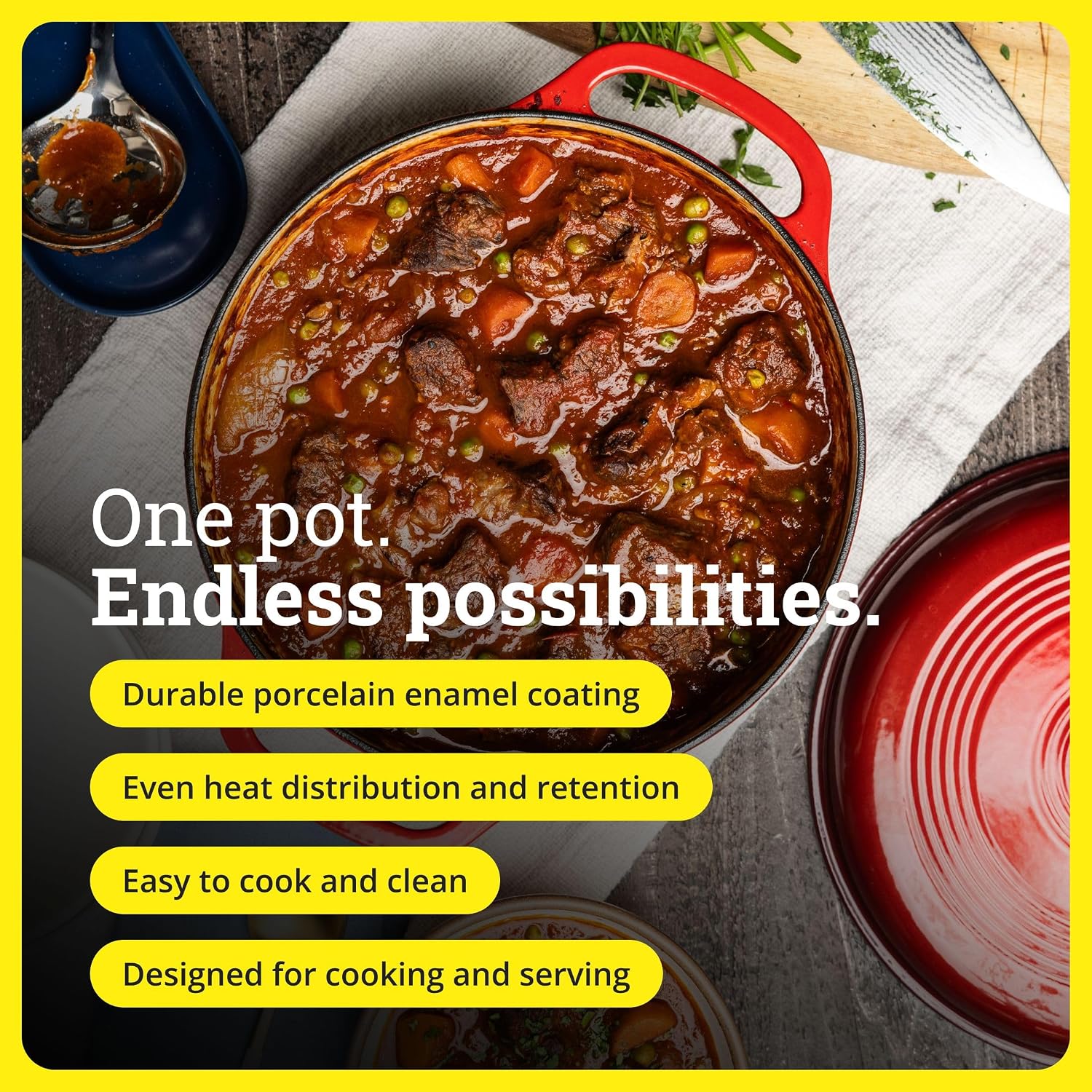
Lodge’s enameled line has accumulated enough long-term owner feedback to identify clear patterns. The word that comes up most consistently in aggregated owner accounts is “lifer” — as in, this pot will outlast me. Owners describe the enamel interior as resistant to staining from tomato-heavy braises and chili bases, easy to clean with minimal effort, and stable under the high-heat browning that chili cooks rely on to build a proper fond layer.
Apartment Therapy’s “Lodge vs. Le Creuset: Is the Price Difference Worth It?” (2024) documents the recurring owner claim that Lodge’s cooking experience is indistinguishable from a pot costing four times as much. For chili specifically, owners report no scorching on low-and-slow simmers, good steam retention through a 3–4 hour cook, and no enamel degradation after repeated high-heat use.
One critical data point in the aggregated record: a Lodge owner noted that a previous enameled pot failed after an accidental dishwasher cycle. The enamel did not chip immediately — it degraded gradually and began to spider-crack near the rim within a few months of that single machine-wash event. This is not a Lodge-specific failure mode; it is how enamel behaves when subjected to dishwasher detergent chemistry and thermal shock. Hand-washing discipline, across the owner record, determines longevity more reliably than brand alone.
Where Lodge falls short: the lid fit on some units is reported as slightly looser than Le Creuset’s, which matters in theory for steam retention but is difficult to detect in a long-simmered chili. The exterior enamel — particularly on darker colorways — shows minor rim chips after 18–24 months of regular use in some accounts. Neither issue affects cooking performance, but both can affect kitchen aesthetics over time.
Lodge
$89.90
In stock on Amazon
Check price on AmazonMisen: The Mid-Tier Pick
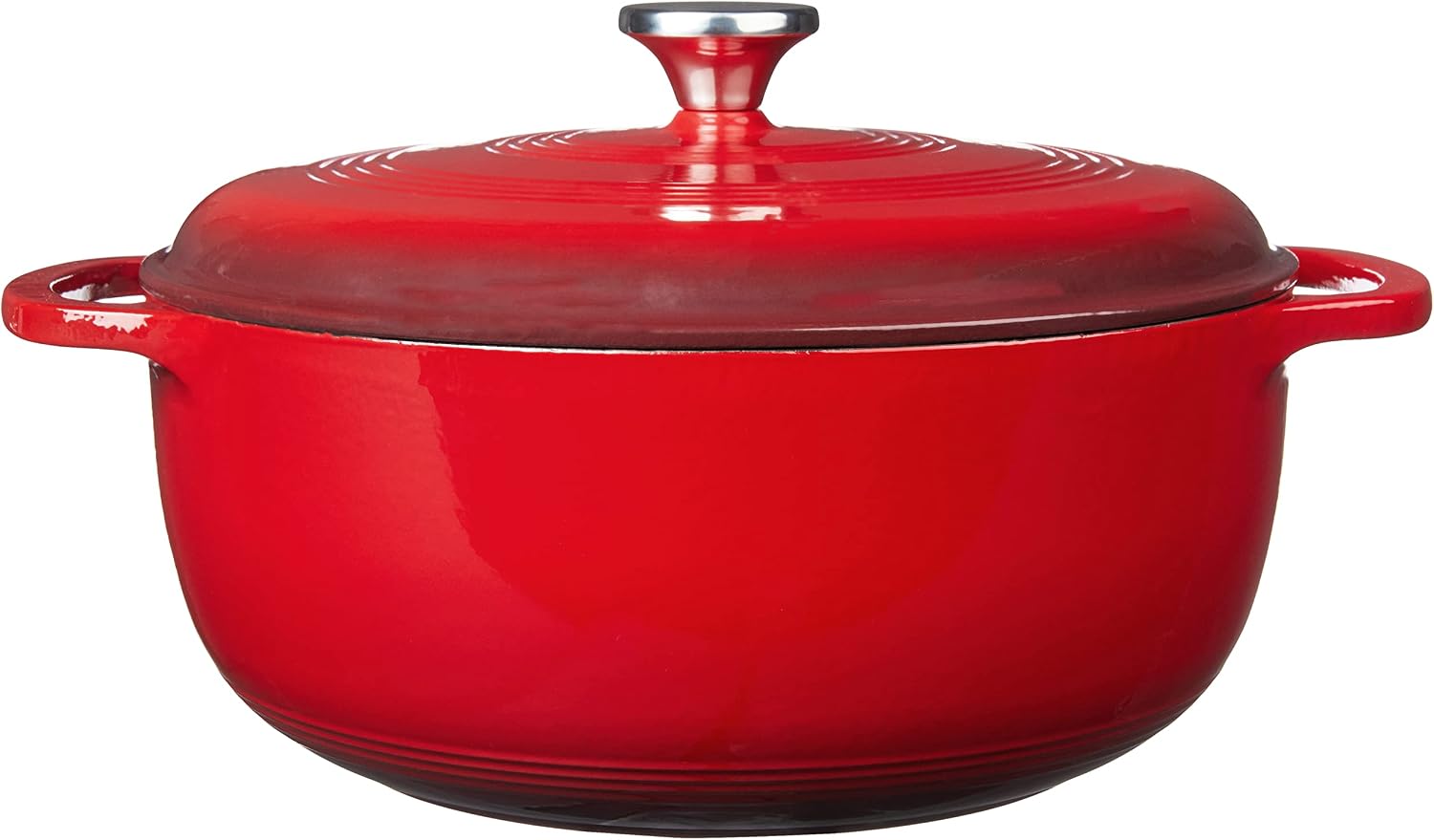
Misen’s enameled Dutch oven is the newest entrant here, and the owner review pool reflects that: it is enthusiastic but thin. Owners praise the thick iron core — Misen’s published specs put their wall thickness in the same range as Le Creuset — and the multi-piece lid system, which features a removable stainless knob that makes the lid oven-safe to higher temperatures than standard phenolic knobs allow.
The chip-resistant enamel claim is Misen’s most prominent differentiator. Their marketing describes a higher-density enamel application relative to standard consumer pots. Owners who have been cooking with the pot for 6–12 months report no chipping and positive impressions of the interior surface.
Here is the honest constraint: Serious Eats, in their 2025 roundup “The Best Dutch Ovens, Tested and Reviewed,” notes explicitly that Misen earns high marks on initial impressions but carries an asterisk on long-term durability pending more owner history. Nobody in the current review record has owned a Misen Dutch oven for three to five years. Enamel durability is a long-game metric, and the data simply does not exist yet.
For chili cooks evaluating Misen, the value proposition sits roughly in the middle of the range: more engineered than Lodge, meaningfully less expensive than Le Creuset, but carrying more uncertainty about what year five looks like. If you are the type of cook who upgrades cookware on a 3–4 year cycle, that uncertainty matters less. If you are buying once and keeping it for a decade, the lack of long-run data is a real gap.
Lodge
$99.90
In stock on Amazon
Check price on AmazonLe Creuset: The Premium Pick
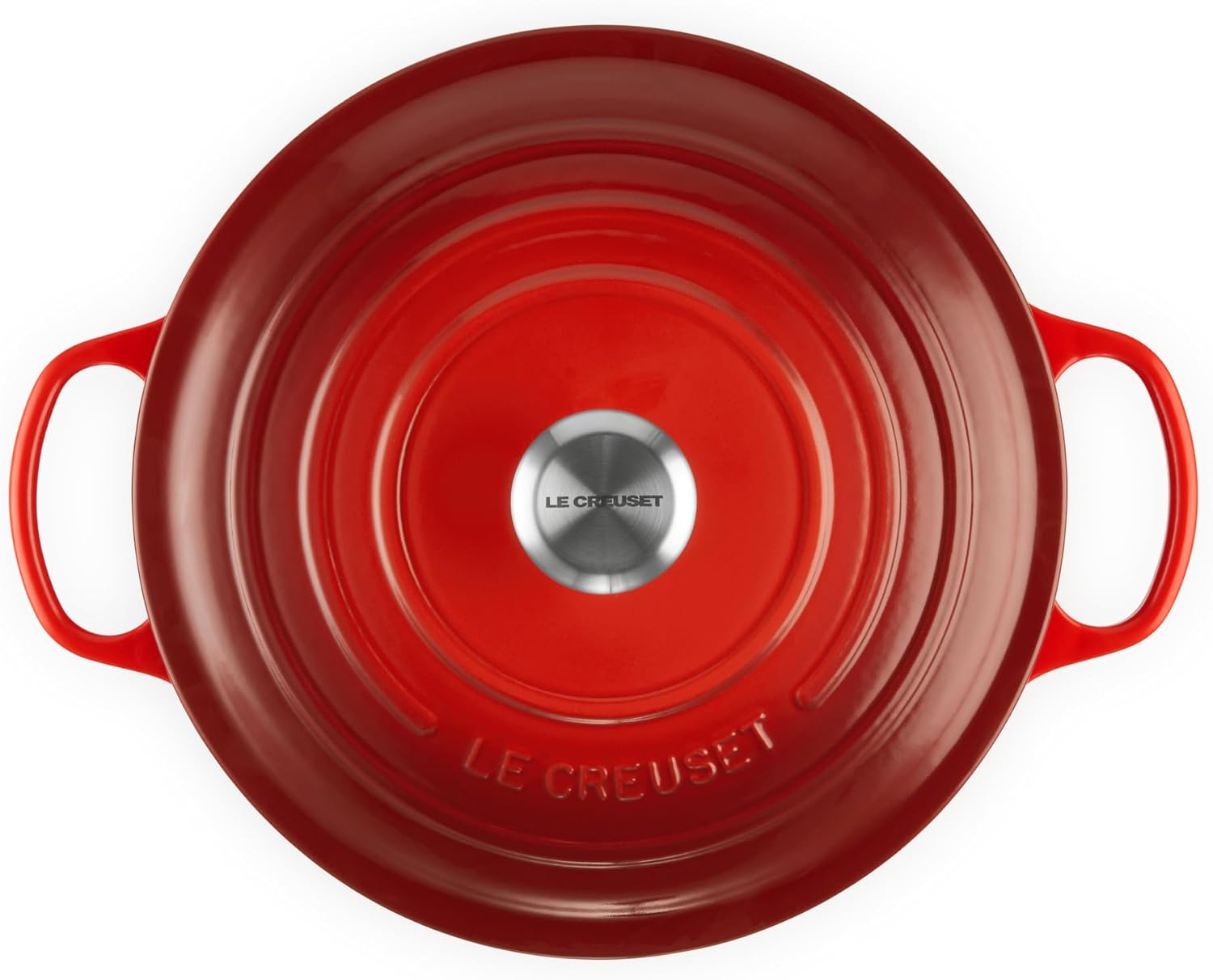
Le Creuset owners are, by a wide margin, satisfied. Wirecutter’s “The Best Dutch Oven” (2025) and Serious Eats’ “The Best Dutch Ovens, Tested and Reviewed” (2025) both document high repurchase intent and a meaningful “I would never use anything else” owner cohort. The enamel interior — Le Creuset’s light sand or cream colorway on the inside — is widely praised for visibility: you can monitor the browning stage of a chili base, spot fond buildup, and see color changes in a way that is harder on darker-interior pots.
But two failure modes show up in the honest owner record.
Weight: A self-described petite owner in aggregated review documentation returned her Le Creuset after a few weeks, citing the combined weight of pot plus lid as genuinely unmanageable for day-to-day use — particularly when moving a full pot of liquid from stovetop to oven. A 5.5 qt. Le Creuset loaded with a full batch of chili can approach 18–20 pounds. If you have wrist, shoulder, or grip concerns, this is worth modeling before buying.
Quality-control consistency: Owners in verified purchase accounts report receiving Le Creuset units with visibly chipped lids on first delivery. Le Creuset’s customer service response to these cases is generally reported as responsive, but the incident undercuts the “you are paying for perfection” premise at a $400 price point.
Where Le Creuset genuinely earns its price: the lid fit is meaningfully tighter than Lodge’s in side-by-side owner comparisons, which may produce a slightly more concentrated result over a 4-hour low simmer. The enamel’s longevity record over 10–15 years of documented use is unmatched in the consumer market. Cook’s Illustrated’s Dutch Oven Buying Guide (2024) identifies this long-run enamel track record as Le Creuset’s clearest functional advantage over newer or lower-cost competitors. If you cook daily and expect to use this pot for decades, the cost-per-year math narrows considerably.
Le
$334.91
In stock on Amazon
Check price on AmazonFrequently Asked Questions
Is Lodge enamel actually as durable as Le Creuset at a fraction of the price?
Owner reports consistently suggest Lodge’s cooking performance is very close to Le Creuset’s in day-to-day use. What Lodge does not have is Le Creuset’s 10–15 year enamel durability track record at scale. The honest answer: for most home cooks cooking 3–5 times per week, Lodge performs at Le Creuset’s level. The gap, if it exists, shows up in years 8–12 — and only if you maintain the hand-washing discipline both brands require.
What happens if you accidentally run an enameled Dutch oven through the dishwasher?
Food52, in their 2024 piece “Why Your Dutch Oven Enamel Chipped — and How to Stop It,” is direct on this point: dishwasher detergents are alkaline and abrasive, and thermal cycling in a machine accelerates micro-fractures in the glass matrix. A single cycle may not cause immediate visible damage, but it initiates degradation that shows up later as spider-cracking or flaking near the rim. The discipline is the same at every price point — hand wash, dry immediately, store without stacking bare cast iron inside.
Is the Le Creuset weight a real ergonomic problem for everyday cooks?
For some owners, yes — and this is underreported in most reviews. A Le Creuset lid alone can weigh 2–3 pounds. Combined with a full pot of chili, maneuvering from stovetop to oven or checking a simmer one-handed becomes fatiguing for smaller-framed cooks or anyone with grip or wrist considerations. If weight is a concern, handle the pot in person before buying.
How does Misen’s chip-resistant enamel claim hold up after extended use?
Current 6–12 month owner accounts are positive — no chipping reported among early adopters. But “chip-resistant” is a manufacturer claim, not an independently verified standard, and no cook in the current record has yet reported on Misen enamel at the 3–5 year mark. Treat this as a promising but unconfirmed differentiator until more owner history accumulates.
Does a tighter lid fit make a measurable difference in a long-simmered chili?
In theory, a tighter seal reduces evaporative loss, which concentrates flavor and reduces mid-cook liquid additions. In practice, the difference between a Lodge lid and a Le Creuset lid over a 3-hour covered simmer is likely small. Where lid fit matters more: shorter cooks, braising applications, or any recipe where moisture retention is load-bearing. For a chili intended to reduce and concentrate anyway, the gap is largely irrelevant.
The Decision Rule
If your Dutch oven budget tops out at $100, Lodge is not a compromise — it is the right answer. Owners with years of hard use consistently call it a lifer, cooking performance tracks with pots costing four times as much, and the failure modes are almost entirely user-driven (dishwasher, hard drops). Buy Lodge, hand-wash it religiously, and put the savings toward better dried chiles.
If you cook daily, plan to keep a single pot for 10–15 years, value the tighter lid fit and proven enamel longevity, and the $400 price point is a stretch rather than a barrier, Le Creuset earns its premium — but verify in person that you can comfortably handle the weight loaded with a full batch of chili.
If you are in the $150–$200 range and want more engineering investment than Lodge offers without committing to Le Creuset’s price, Misen is a credible bet — with the honest caveat that you are making a calculated wager on long-term enamel durability that the current owner record cannot yet confirm. Give it two more years of aggregated reviews and the picture will be clearer.
The pot that makes the best chili is the one you use every week without hesitation. On that metric, the owner record is unambiguous: all three of these, treated well, will get you there.